Apple Support documentation details how iPhone Mirroring lets users wirelessly interact with an iPhone, its apps, and its notifications from a Mac. This guide summarizes documented system requirements, initial setup steps, security protections, hardware boundaries, and navigation controls based on Apple Support documentation.
System Requirements and Prerequisites
iPhone Mirroring connects one Mac and one iPhone at a time. Both devices must meet the following documented requirements:
- Mac: macOS Sequoia 15 or later on a Mac with Apple silicon or the Apple T2 Security Chip.
- iPhone: iOS 18 or later configured with a passcode.
- Apple Account: Both devices must be signed in to the same Apple Account using two-factor authentication.
- Connectivity and Proximity: Wi-Fi and Bluetooth must be turned on on both devices. The iPhone must be locked and near the Mac (it can also be charging and using StandBy).
- Feature Conflicts: The Mac must not be sharing its internet connection or using AirPlay or Sidecar.
- Regional Availability: iPhone Mirroring is currently unavailable in the European Union.
Initial Setup and Connection Steps
To set up and connect iPhone Mirroring on a Mac:
- Open iPhone Mirroring on your Mac from the Dock, Applications folder, Spotlight, or Siri AI (it is included with macOS Sequoia 15 or later).
- If the Mac asks you to unlock your iPhone, enter the iPhone passcode on the physical iPhone.
- When asked whether to allow notifications from the iPhone, choose Allow or Don’t Allow. This can be adjusted later in Notifications settings on the Mac.
- When asked whether to require a Mac login to access the iPhone, select whether to be asked every time or to authenticate automatically. This setting can be adjusted later in iPhone Mirroring settings.
When the iPhone Mirroring window displays the iPhone screen, the devices are connected. To stop mirroring, quit the iPhone Mirroring app on the Mac or unlock the iPhone.
Security Architecture and Device Auditing
Apple documents specific privacy and security measures during and after mirroring sessions:
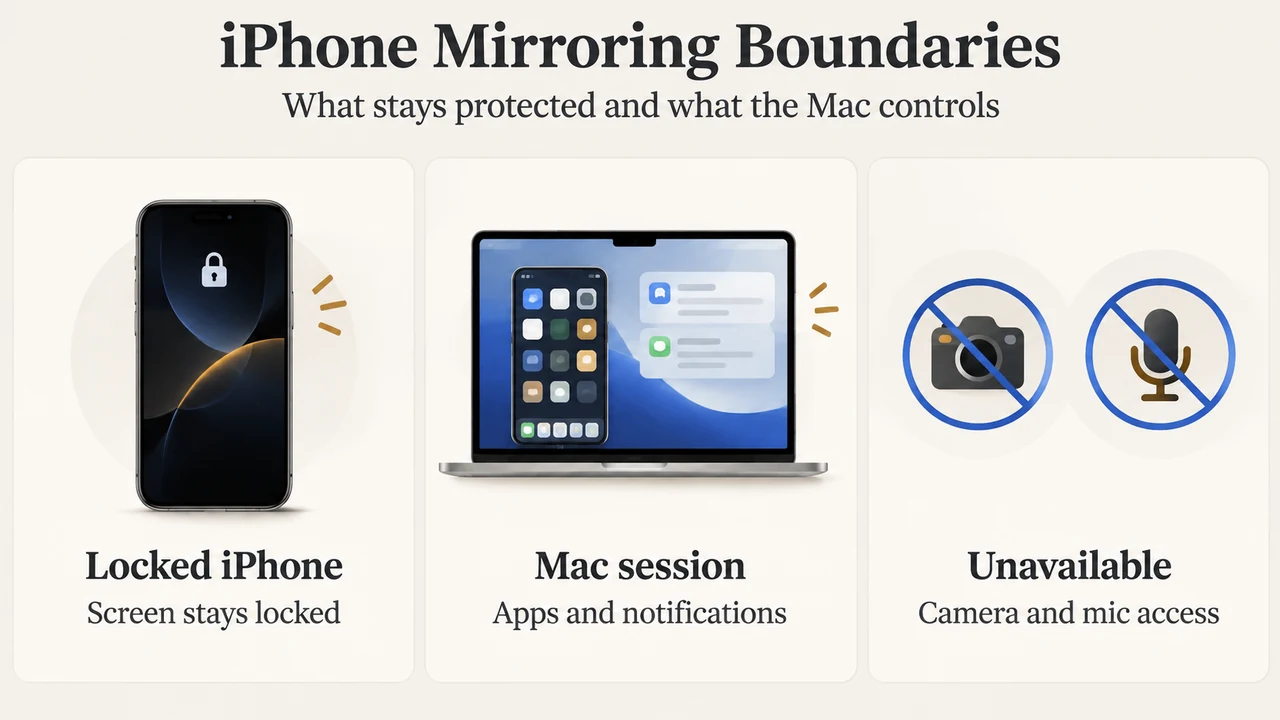
- Screen Lock: The physical iPhone remains locked while mirroring is active so that others cannot access it or see what is happening. During a session, the iPhone indicates that it is in use and identifies the Mac connected to it.
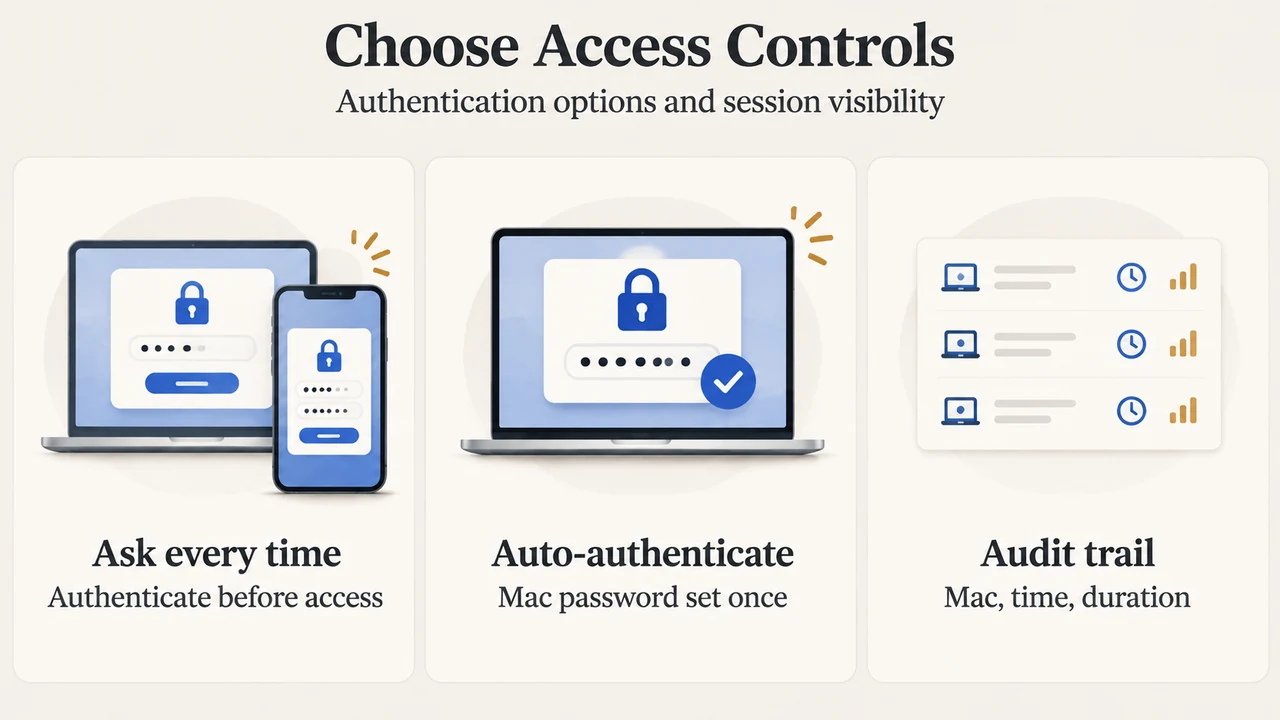
- Session Auditing: When unlocked after mirroring, the iPhone indicates that it was used from a Mac. It links to
Settings > General > AirPlay & Continuity > iPhone Mirroring, which identifies the Mac that used the iPhone, including when and for how long. - Automatic Pause: iPhone Mirroring automatically pauses the connection after periods of inactivity.
- Authentication Settings: In the iPhone Mirroring menu on macOS under Settings, users can configure:
- Ask every time: Requires authentication before mirroring using the Mac login password, Touch ID, or Apple Watch.
- Authenticate automatically: Bypasses prompts after entering the Mac login password once. Selecting this keeps the Mac Lock Screen setting “Require password after screen saver begins or display is turned off” set to Immediately.
- Revoke iPhone Access: Resets iPhone Mirroring setup and removes “Allow notifications from iPhone” from Mac Notifications settings.
Hardware and Peripheral Boundaries
Vendor documentation outlines specific functional boundaries during iPhone Mirroring:
- Camera and Microphone: Access to the iPhone camera and microphone is not available in iPhone Mirroring, including for Face ID or phone calls.
- Phone Calls: Users can make and receive phone calls on the Mac instead. To place calls from the Mac while iPhone Mirroring is active, both devices must have Wi-Fi Calling turned on.
- Game Controllers: To use a wireless game controller with supported iPhone apps, the controller must be connected via Bluetooth directly to the iPhone instead of the Mac.
- Audio and Video Playback: iPhone audio plays through the Mac and is volume-controlled by the Mac, unless headphones are connected to the iPhone. iPhone video plays in the iPhone Mirroring window, though streaming content providers may enforce playback restrictions on premium video content.
Navigation Controls and Shortcuts (macOS Sequoia 15)
On macOS Sequoia 15, users interact with the mirrored iPhone screen using standard inputs and shortcuts:
- Tap and Hold: Click wherever you would tap on the iPhone; click and hold wherever you would touch and hold.
- Horizontal Swipe: Press and hold the Shift key while scrolling with a mouse or trackpad.
- Home Screen: Click the Home Screen button in the toolbar, click the bar at the bottom of the window, or press Command-1.
- App Switcher: Click the App Switcher button in the toolbar or press Command-2.
- Spotlight: Scroll or swipe up from the Home Screen, or press Command-3.
- Window Sizing: In the View menu, choose from three preset sizes (Larger, Smaller, or Actual Size), or press Command–Plus (+), Command–Minus (–), or Command-0.
Controls and Capabilities in Later macOS Versions
The documentation notes several controls and integrations that require versions beyond macOS Sequoia 15:
- Control Center Shortcut: Pressing Command-4 to open Control Center requires macOS 27 or later.
- Corner Dragging and Size Reset: Dragging a corner to resize the window (with expanded views in apps such as Mail, Messages, and Calendar) and returning to standard size via the toolbar button or Command-9 requires macOS 27 or later.
- Live Activities on Mac: Receiving Live Activities from the iPhone requires macOS Tahoe 26 or later.
- Spotlight iPhone App Launching: Using Spotlight or Siri AI on Mac to find and open iPhone apps requires macOS Tahoe 26 or later.
- Selecting Active iPhone: When multiple iPhones are available, choosing the active iPhone via
System Settings > General > AirDrop & Continuityrequires macOS Tahoe 26.4 or later (earlier macOS versions useSystem Settings > Desktop & Dock).
Research Method and Limitations
This guide was prepared directly from public vendor documentation published by Apple Support (document 120421, retrieved September 2026). No lab tests, independent device benchmarks, or competing editorial coverages were evaluated. Coverage is limited strictly to the facts and instructions visible in the supplied documentation excerpt.
Text version of the diagrams
- iPhone Mirroring Boundaries: Locked iPhone — Screen stays locked; Mac session — Apps and notifications; Unavailable — Camera and mic access
- Choose Access Controls: Ask every time — Authenticate before access; Auto-authenticate — Mac password set once; Audit trail — Mac, time, duration