Apple Lockdown Mode is an optional, extreme protection designed for the very few individuals who might be personally targeted by extremely rare and highly sophisticated digital threats, such as mercenary spyware, because of who they are or what they do. Most people are never targeted by attacks of this nature. When enabled, the device does not function like it typically does; certain apps, websites, and features are strictly limited for security, and some experiences are unavailable.
Lockdown Mode is available on iOS 16 or later, iPadOS 16 or later, watchOS 10 or later, and macOS Ventura or later, with additional protections available starting in iOS 17, iPadOS 17, watchOS 10, and macOS Sonoma. Apple notes that users should update their devices to the latest software before turning on Lockdown Mode for a complete set of protections.
Who Lockdown Mode Is Designed For
According to Apple’s documentation, Lockdown Mode is built strictly for the few individuals who face targeted cyber attacks. Most people do not face threats of this kind. Because turning on Lockdown Mode alters routine functions across messaging, web browsing, incoming calls, and device connectivity, it changes the normal user experience.
Feature Restrictions Across Apps and Services
When Lockdown Mode is active, documented protections include:
- Messages: Most message attachment types are blocked, except for certain images, video, and audio. Features like links and link previews are unavailable.
- Web Browsing: Complex web technologies are blocked, which may cause some websites to load more slowly or not work correctly. Web fonts might not display, and images might be replaced with a missing image icon. A banner in Safari indicates that Lockdown Mode is turned on.
- FaceTime: Incoming FaceTime calls are blocked unless you previously called that person or contact within the past 30 days. Features such as SharePlay and Live Photos are unavailable.
- Apple Services: Incoming invitations for Apple services—such as invitations to manage a home in the Home app—are blocked unless you previously invited that person. Focus and related status will not work as expected. Game Center is disabled.
- Photos: Location information is excluded when sharing photos. Shared albums are removed from the Photos app, and new Shared Album invitations are blocked. Shared albums remain viewable on other devices that do not have Lockdown Mode enabled.
Device Connections, Wireless, and Cellular Limits
Lockdown Mode enforces specific connectivity rules:
- Device Connections: To connect an iPhone or iPad to an accessory or another computer, the mobile device must be unlocked. To connect a Mac laptop with Apple silicon to an accessory, the Mac must be unlocked and explicit approval must be provided.
- Wireless Networks: The device will not automatically join non-secure Wi-Fi networks and will disconnect from a non-secure Wi-Fi network when Lockdown Mode is turned on.
- Cellular Networks: 2G and 3G cellular support is turned off for iPhone and iPad.
- Phone Calls and Emergency SOS: Standard phone calls and plain text messages continue to work, though incoming calls will not ring on a paired Apple Watch. Emergency features, such as SOS emergency calls, are not affected.
How to Turn On Lockdown Mode
Lockdown Mode must be enabled separately on each iPhone, iPad, or Mac. Turning it on for an iPhone automatically enables it on a paired Apple Watch, and turning it on on one device prompts you to turn it on for other supported Apple devices.
On iPhone or iPad
- Open the Settings app.
- Tap Privacy & Security.
- Scroll down, tap Lockdown Mode, then tap Turn On Lockdown Mode.
- Tap Turn On Lockdown Mode again.
- Tap Turn On & Restart, then enter your device passcode.
On Mac
- From the Apple menu, choose System Settings.
- From the sidebar, click Privacy & Security.
- Scroll down, click Lockdown Mode, then click Turn On.
- Click Turn On Lockdown Mode (entering the user password if prompted).
- Click Turn On & Restart.
Configuration Profiles and Mobile Device Management
While Lockdown Mode is on, new configuration profiles cannot be installed, and the device cannot be enrolled in Mobile Device Management (MDM) or device supervision. Apple states these restrictions prevent attackers from attempting to install malicious profiles. To install a configuration profile or management profile, a user must turn off Lockdown Mode, install the profile, and then re-enable Lockdown Mode if necessary.
A device already enrolled in MDM before Lockdown Mode is enabled remains managed, and system administrators can install and remove configuration profiles on that device. However, Lockdown Mode is not a configurable option for MDM by administrators.
Exclusions for Websites, Apps, and Contacts
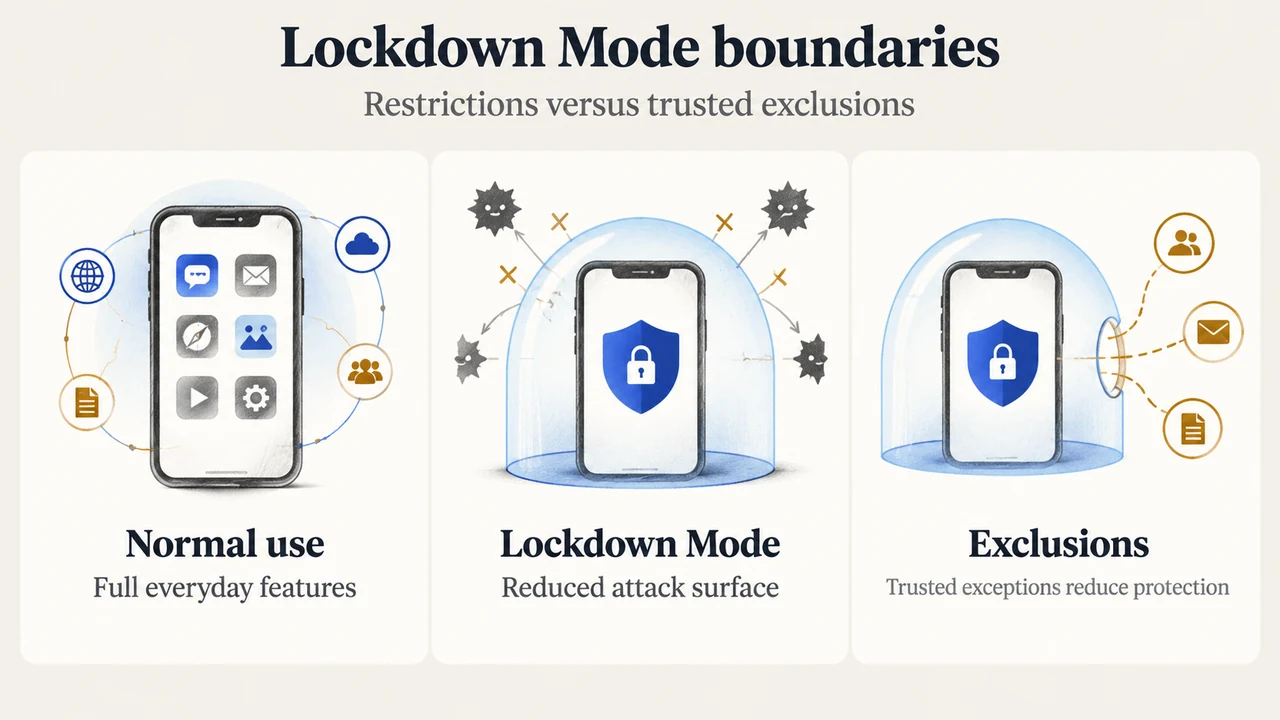
Excluding an item reduces protections and can increase security risk. Apple advises excluding only trusted websites, apps, or contacts, and only if necessary. Exclusion settings appear only after Lockdown Mode is enabled:
- Websites: In Safari, a website can be excluded by opening the Page Menu (on iPhone/iPad) or Safari Settings for the website (on Mac) and turning off Lockdown Mode, which removes WebKit restrictions for that site. Excluded sites can also be managed under Privacy & Security > Lockdown Mode.
- Apps (iOS and iPadOS): Under Settings > Privacy & Security > Lockdown Mode > Customize Web Sites, web content limits can be turned off for specific apps opened since enabling Lockdown Mode that have limited functionality.
- Contacts (requires version 27 or later of iOS, iPadOS, or macOS): Specific contacts can be added under Customize Contacts to turn off messaging limits for that person. If a contact is removed from the list, or if their phone number or email address changes, message limits return automatically and a notification is sent.
Research Method and Limitations
This explainer was prepared solely from Apple Support documentation (article 105120, published September 14, 2026). No lab tests, device benchmarks, or reverse engineering were conducted. No competing coverage was retrieved or reviewed. Descriptions are limited to documented system rules and behaviors visible in the supplied excerpt.
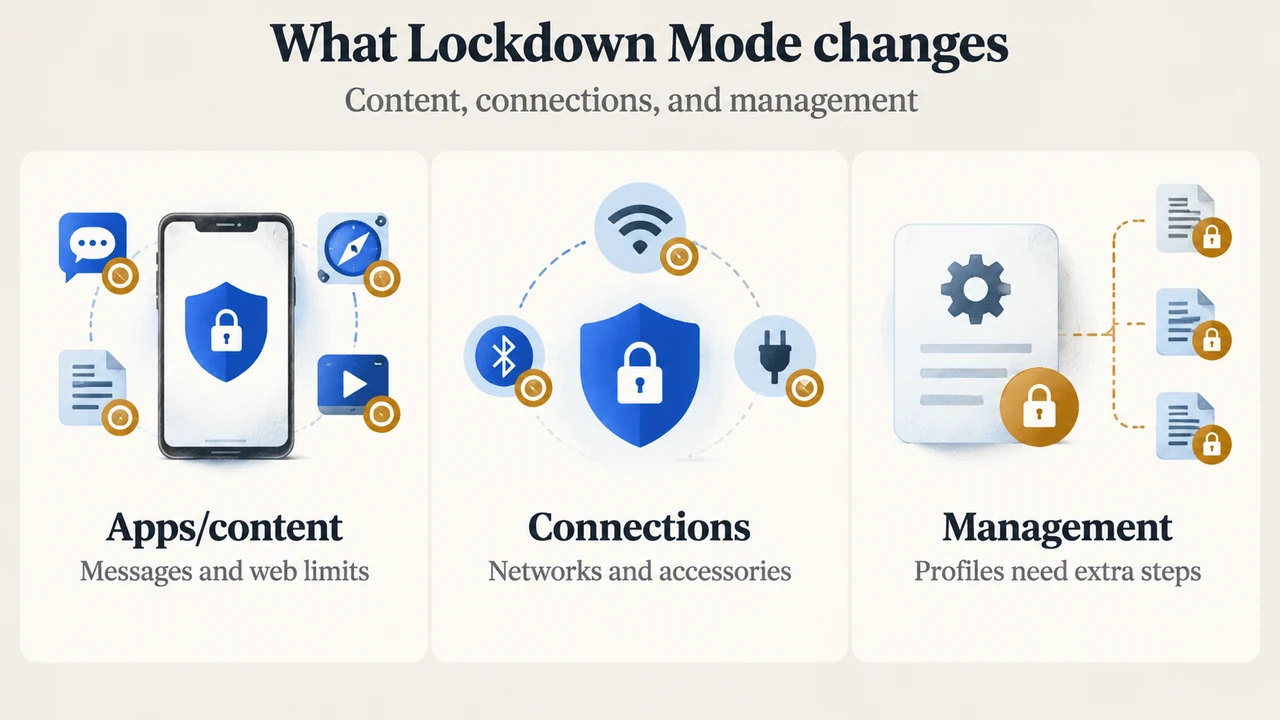
Text version of the diagrams
- Lockdown Mode boundaries: Normal use — Full everyday features; Lockdown Mode — Reduced attack surface; Exclusions — Trusted exceptions reduce protection
- What Lockdown Mode changes: Apps/content — Messages and web limits; Connections — Networks and accessories; Management — Profiles need extra steps