The Android Open Source Project (AOSP) and the Bluetooth Special Interest Group (Bluetooth SIG) define specific software architecture boundaries and formal specifications for Bluetooth communications.
AOSP Bluetooth Stack Architecture
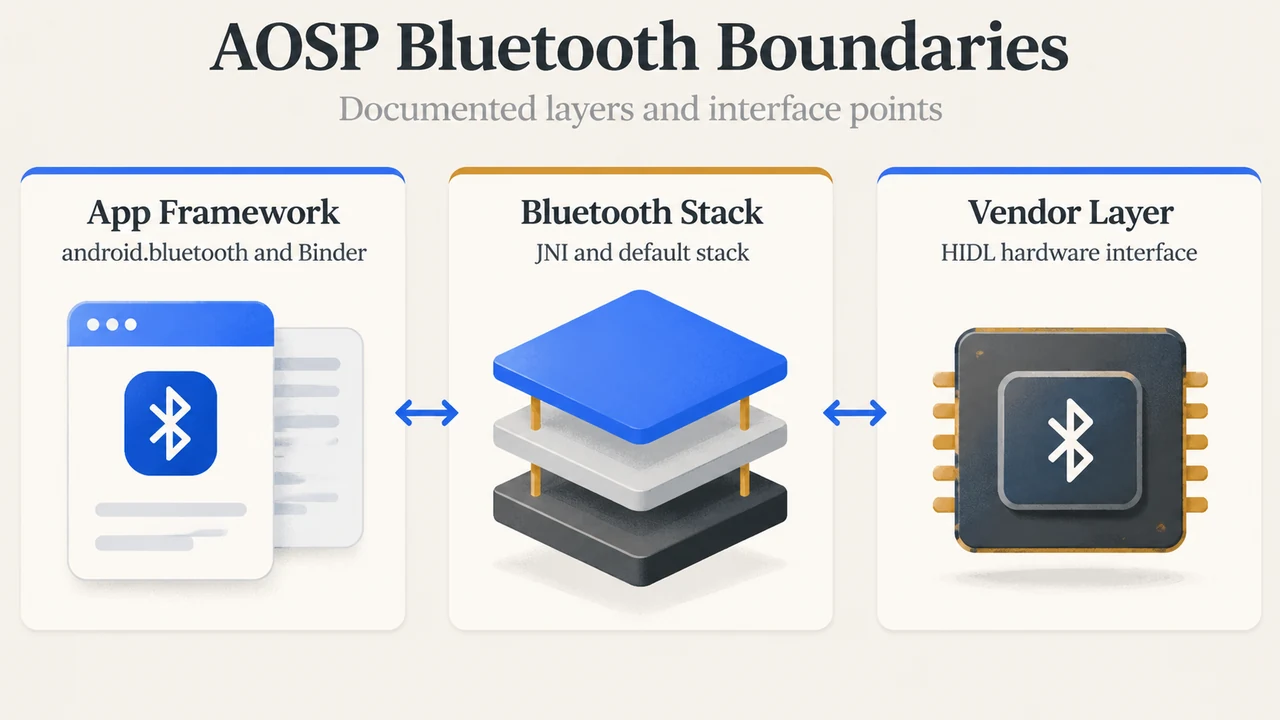
According to official AOSP documentation (AOSP Bluetooth Core Topics), Android provides a default Bluetooth stack supporting both Classic Bluetooth and Bluetooth Low Energy (BLE). The stack is organized across several software layers:
- Application Framework: Application code at this level uses
android.bluetoothAPIs to interact with Bluetooth hardware. Internally, this framework code calls the Bluetooth process using Binder inter-process communication (IPC). - Bluetooth Application: Located in
packages/modules/Bluetooth/android/app, this component is packaged as an Android app and implements Bluetooth profiles at the Android framework layer. It calls into the Bluetooth stack through the Java Native Interface (JNI). - JNI Layer: The JNI code associated with
android.bluetoothis located inpackages/modules/Bluetooth/android/app/jni. It calls into the Bluetooth stack when operations such as device discovery occur. - Default Bluetooth Stack: Maintained in
packages/modules/Bluetooth/system, the default stack implements the generic Bluetooth Hardware Abstraction Layer (HAL) and applies extensions and configuration changes. The core Bluetooth stack resides inpackages/modules/Bluetoothand is registered on the Bluetooth SIG website under QDID 169365. - Vendor Implementation & HIDL: Hardware vendors interact with the Bluetooth stack using the HAL Interface Definition Language (HIDL). The interface files are located in
hardware/interfaces/bluetoothand are converted using the HIDL generation tool to define the interface between the stack and vendor hardware implementations.
Hardware and Chipset Requirements
The capabilities available through the Android platform depend on hardware qualification:
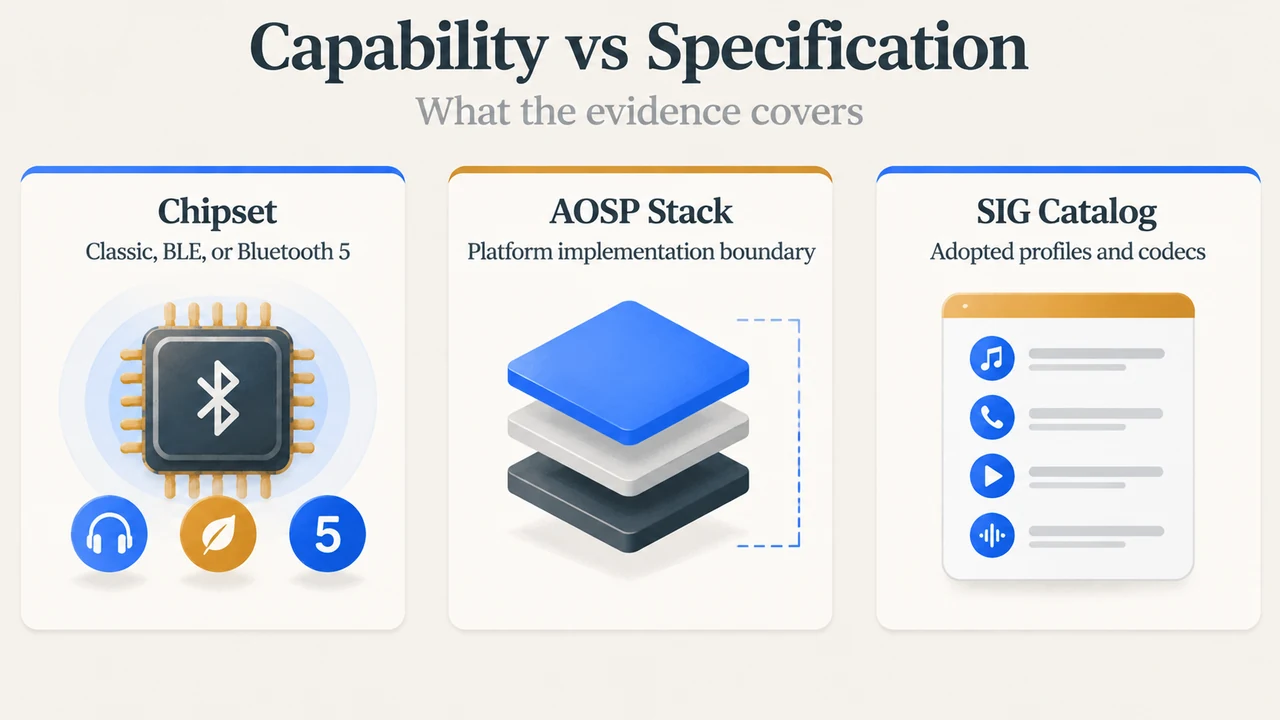
- Android devices with a qualified chipset can implement either Classic Bluetooth or both Classic Bluetooth and BLE.
- BLE is not backward compatible with older Bluetooth chipsets lacking BLE hardware support.
- Android 8.0 qualified the Bluetooth stack for Bluetooth 5. To use available Bluetooth 5 features, the physical host device must possess a Bluetooth 5 qualified chipset.
Adopted Bluetooth Audio and Media Specifications
The Bluetooth SIG Specifications List catalogs adopted specifications governing audio streaming and device interaction. Examples appearing in the visible adopted specification index include:
- Advanced Audio Distribution Profile (A2DP): Cataloged under adopted versions 1.2, 1.3.2, 1.4, and 1.4.1.
- Audio/Video Transport Protocols: Cataloged as A/V Distribution Transport Protocol (AVDTP) version 1.3 and A/V Control Transport Protocol (AVCTP) version 1.4.
- Low Complexity Communication Codec (LC3): Formally cataloged in adopted versions 1.0 and 1.0.1.
- Media and Audio Services: Cataloged entries include Media Control Profile version 1.0, Media Control Service (versions 1.0 and 1.0.1), and Published Audio Capabilities Service (versions 1.0.1 and 1.0.2).
Text version of the diagrams
- AOSP Bluetooth Boundaries: App Framework — android.bluetooth and Binder; Bluetooth Stack — JNI and default stack; Vendor Layer — HIDL hardware interface
- Capability vs Specification: Chipset — Classic, BLE, or Bluetooth 5; AOSP Stack — Platform implementation boundary; SIG Catalog — Adopted profiles and codecs
Research Method and Limitations
This technical summary was prepared exclusively using the supplied public source excerpts from AOSP core documentation and the Bluetooth SIG specifications directory. Material limitations exist in the visible evidence: the Bluetooth SIG excerpt is a truncated, partial catalog without specification text, protocol state machine diagrams, or negotiation workflows. Similarly, the primary AOSP excerpt documents process boundaries, module paths, and IPC mechanisms, but does not provide runtime profile negotiation algorithms or dynamic bitrate ladder procedures. While secondary commentary from SoundGuys was reviewed during initial source gathering, it was not used to support the technical architecture or specification facts presented here.