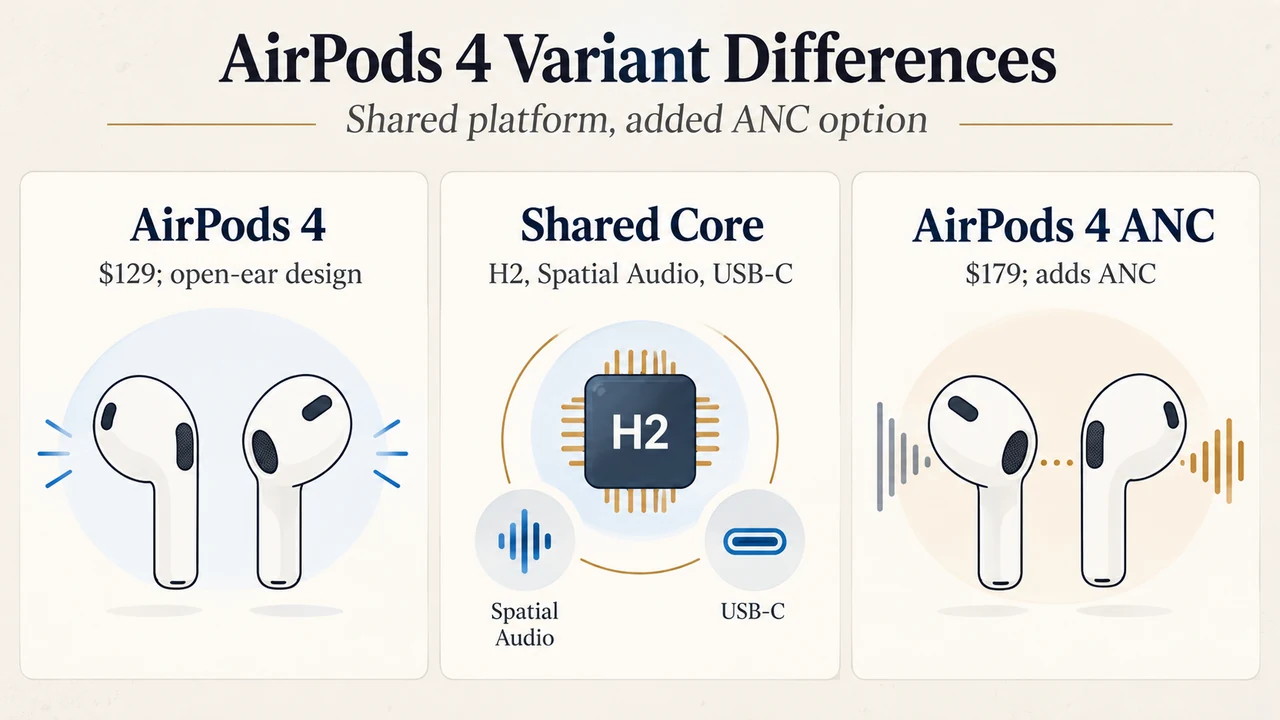
The standard Apple AirPods 4 and Apple AirPods 4 with Active Noise Cancellation share Apple’s open-ear physical design and H2 chip platform, but Apple differentiates them by price, acoustic noise management, and documented charging options.
Documented Specifications and Differences
| Feature | Apple AirPods 4 | Apple AirPods 4 with Active Noise Cancellation |
|---|---|---|
| Announced U.S. Price | $129 | $179 |
| Acoustic Design | Open-ear fit | Open-ear fit with Active Noise Cancellation |
| Processor | Apple H2 chip | Apple H2 chip |
| Acoustic Architecture | Low-distortion driver, high dynamic range amplifier | Low-distortion driver, high dynamic range amplifier |
| Audio Features | Personalized Spatial Audio with dynamic head tracking | Personalized Spatial Audio with dynamic head tracking |
| Voice and Interaction | Voice Isolation, Siri Interactions (nod yes / shake no) | Voice Isolation, Siri Interactions (nod yes / shake no) |
| Stem Control | Force sensor (play/pause media, mute/end calls) | Force sensor (play/pause media, mute/end calls) |
| Gaming Audio Support | Low latency, 16-bit 48kHz audio support | Low latency, 16-bit 48kHz audio support |
| Battery Life (with case) | Up to 30 hours | Up to 30 hours |
| Charging Methods Supported in Evidence | USB-C charging | USB-C charging cable, Apple Watch charger, or Qi-certified charger |
| Charging Case Details | Over 10 percent smaller in volume than predecessor | 50mm wide; smallest in industry with wireless charging capabilities |
Shared Features on Both Models
According to Apple’s launch announcement, both AirPods 4 models feature an open-ear design shaped with data gathered from 3D photogrammetry and laser topography. Both models incorporate a low-distortion driver, a high dynamic range amplifier, and Personalized Spatial Audio with dynamic head tracking.
The built-in Apple H2 chip provides identical core processing capabilities across both versions:
- Voice Isolation: Delivers clearer call quality regardless of environmental conditions.
- Siri Interactions: Lets users nod yes or gently shake their head no to respond to Siri announcements.
- Force Sensor: Located on the stem to play or pause media, as well as mute or end calls with a press.
- Gaming Audio: Delivers low wireless audio latency and supports 16-bit, 48kHz voice quality for chatting.
Hardware and Charging Case Differences
The primary documented distinctions between the two variants are:
- Active Noise Cancellation: The $179 model brings Active Noise Cancellation to the open-ear design, whereas the standard $129 model does not include Active Noise Cancellation in the supplied text.
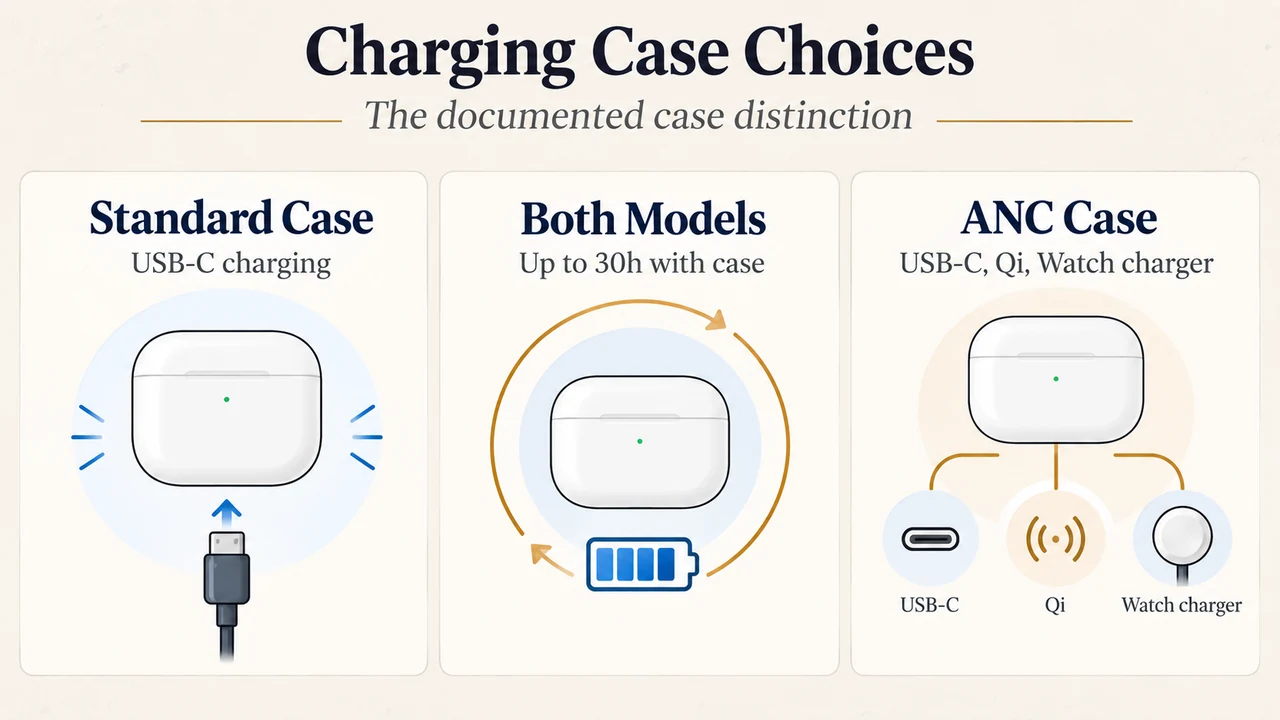
- Wireless Charging Hardware: The AirPods 4 with Active Noise Cancellation charging case supports charging with an Apple Watch charger or a Qi-certified charger in addition to a USB-C charging cable. Apple states this 50mm wide case is the smallest in the industry with wireless charging capabilities. For the standard AirPods 4, the evidence documents USB-C charging and a volume reduction of more than 10 percent versus its predecessor, but does not document wireless charging support.
Environmental Materials
Apple documents that the AirPods 4 design uses 100 percent recycled rare earth elements in all magnets and 100 percent recycled gold in the plating of multiple printed circuit boards. The charging case uses 100 percent recycled tin in the solder of the main logic board and 100 percent recycled aluminum in the hinge. The hardware is free of mercury, brominated flame retardants (BFRs), and PVC.
Research Method and Material Limitations
This comparison was prepared solely from the supplied public source excerpts. The evidence consists of an excerpt from an Apple Newsroom announcement and an RTINGS comparison URL. The Apple excerpt is truncated mid-sentence in the pricing and availability section, establishing U.S. launch pre-orders at $129 and $179 but lacking complete regional availability details for the ANC variant. Furthermore, the RTINGS comparison tool URL redirected to a general landing page without model-specific test measurements or side-by-side analysis. The visible evidence does not establish whether the standard case explicitly lacks wireless charging hardware, nor does it contain laboratory attenuation measurements or comparative user testing.
Text version of the diagrams
- AirPods 4 Variant Differences: AirPods 4 — $129; open-ear design; Shared Core — H2, Spatial Audio, USB-C; AirPods 4 ANC — $179; adds ANC
- Charging Case Choices: Standard Case — USB-C charging; Both Models — Up to 30h with case; ANC Case — USB-C, Qi, Watch charger