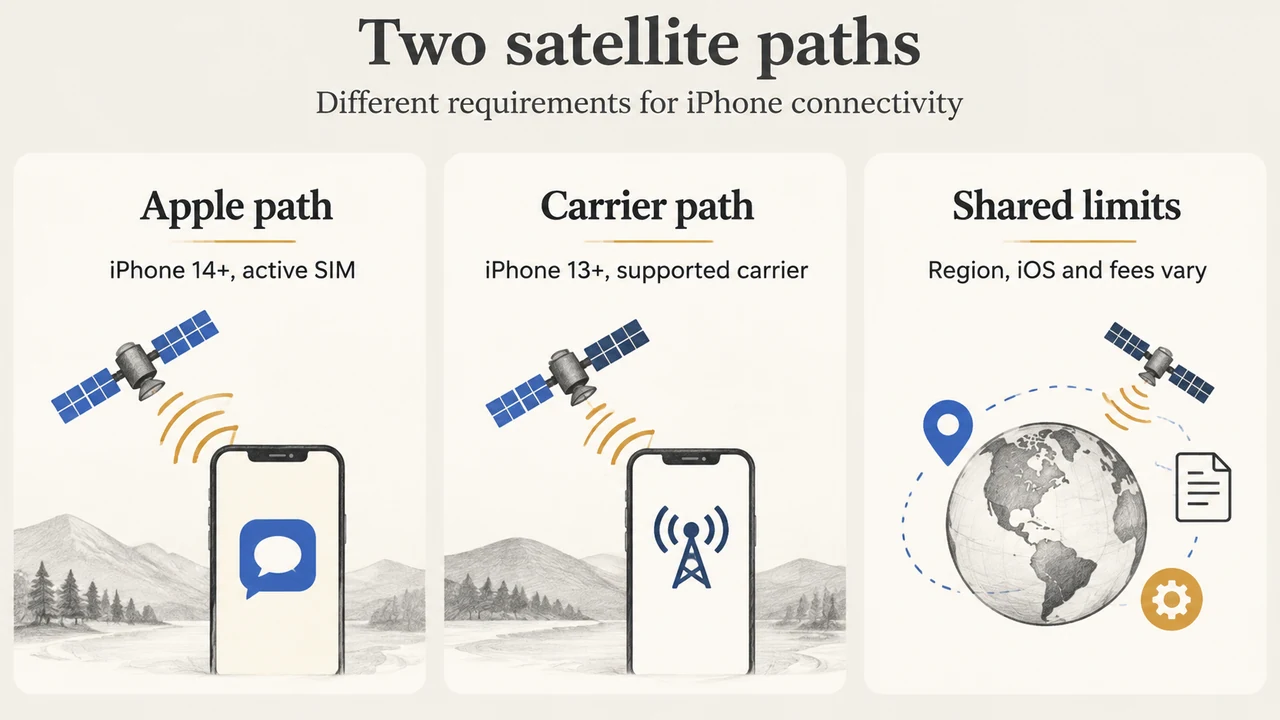
Apple documents two separate satellite paths for iPhone users outside traditional cellular and Wi-Fi coverage: Apple’s own satellite features and satellite connectivity provided by some mobile carriers. They do not have the same requirements.
For Apple’s Messages via satellite, you need an iPhone 14 or later, an active SIM, a supported region and the required iOS version. For carrier-provided satellite features, Apple lists iPhone 13 or later, the latest iOS, a supported carrier and, in some cases, a supported cellular plan. Carrier fees or data rates may apply.
Apple Messages via satellite: the documented requirements
Apple says Messages via satellite works on iPhone 14 or later, all models. The minimum iOS version is iOS 18 or later in the United States, Canada and Japan, and iOS 18.4 or later in Mexico. You also need an active SIM.
Apple lists availability in the United States, Canada, Mexico and Japan. Availability in other regions depends on government regulation, approvals and other market-specific requirements. Apple also says satellite connectivity is not offered on iPhone models purchased in Armenia, Belarus, mainland China, Kazakhstan or Russia. For models purchased in Hong Kong and Macao, Apple lists satellite connectivity only on iPhone 16e and later.
These are documented availability limits, not a guarantee that every satellite feature works in every listed location. Check Apple’s Messages via satellite support page for the region and model context that applies to your device.
What Messages via satellite can and cannot do
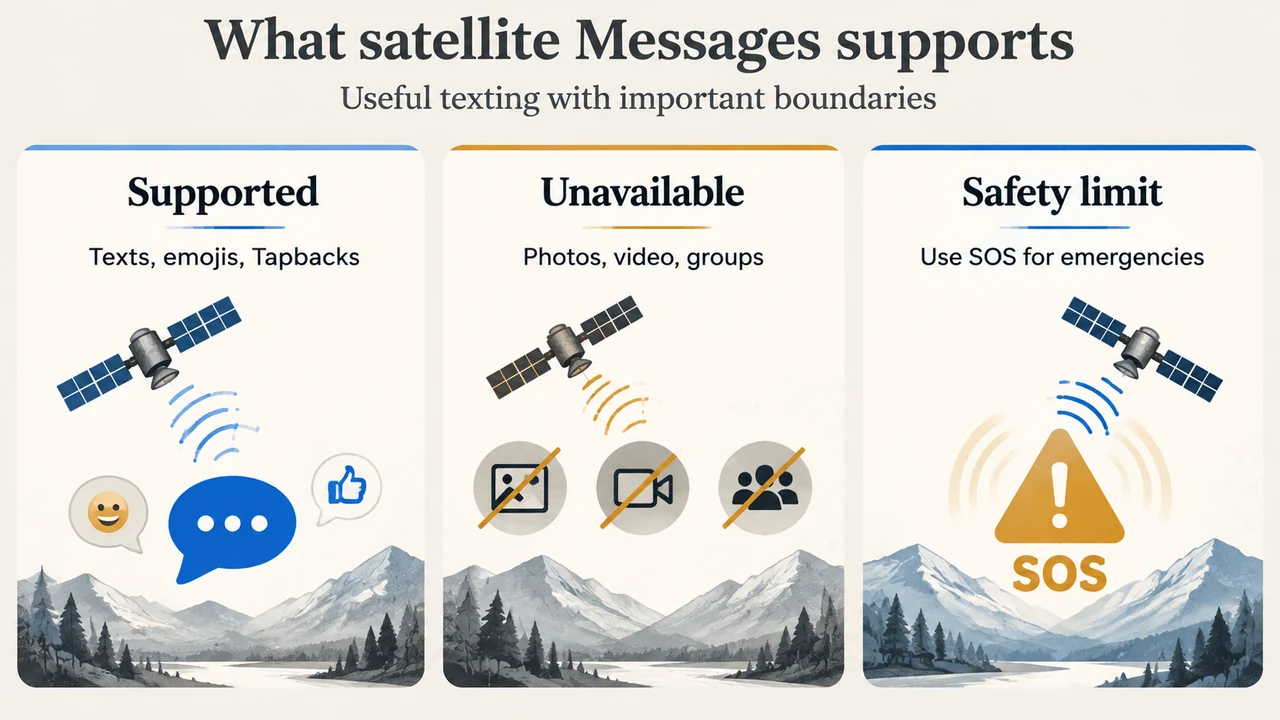
Apple says Messages via satellite can send and receive texts, emojis and Tapbacks through iMessage and SMS when you are outside mobile and Wi-Fi coverage. You need to be outside with a clear view of the sky and horizon and must connect to a satellite with the iPhone.
Some message features are not supported over this connection. Apple lists photos, videos, audio messages, stickers and group messages as unsupported. If an iMessage cannot be sent by satellite, SMS may be available instead, but SMS availability depends on the network provider and provider fees may apply.
Apple says an iMessage contact needs iOS 18 or later to receive iMessages via satellite. To reply to SMS messages via satellite, the contact needs iOS 17.6 or later or a non-Apple device. Apple also says you must turn on iMessage before leaving mobile and Wi-Fi coverage to use iMessage via satellite.
Apple describes satellite messages as potentially slower than ordinary messages. In ideal conditions with a direct view of the sky and horizon, a message may take 30 seconds to send. Under light or medium foliage, it may take over a minute, and heavy foliage or other obstructions may prevent a connection.
Carrier-provided satellite features: a separate eligibility check
Apple says some carriers have enhanced their cellular networks through partnerships with satellite providers. For these carrier-provided features, Apple lists iPhone 13 or later, any model, the latest version of iOS and a supported carrier. Some carriers may also require a supported cellular plan.
When the iPhone uses a carrier-provided satellite feature, Apple says the status bar displays “SAT”. Depending on the carrier, messaging may be available and limited data may work in selected apps. Apple does not say that every carrier offers the same features. Carrier fees and data rates may apply, and Apple directs users to their carrier for supported countries or regions and plan details.
This means an iPhone 13 may meet Apple’s listed device requirement for a carrier feature while not meeting the iPhone 14 requirement for Apple’s Messages via satellite. Meeting the model requirement alone does not establish carrier, plan, region or feature support.
Quick comparison
| Check | Apple Messages via satellite | Carrier-provided satellite |
|---|---|---|
| iPhone | iPhone 14 or later, all models | iPhone 13 or later, any model |
| Software | iOS 18 or later in the US, Canada and Japan; iOS 18.4 or later in Mexico | Latest version of iOS |
| Network or plan | Active SIM; SMS depends on network provider | Supported carrier; some plans may be required |
| Location | US, Canada, Mexico and Japan, subject to Apple’s stated limits | Ask the carrier about supported countries or regions |
| Charges | Apple says it is free for two years after activating an iPhone 14 or later; provider fees may apply to SMS | Carrier fees and data rates may apply |
A practical check before you go off the grid
- Identify the iPhone model. iPhone 14 or later is the model threshold Apple lists for Messages via satellite. iPhone 13 or later is the threshold Apple lists for carrier-provided satellite features.
- Check the iOS requirement for the feature and region. Apple lists regional minimums for Messages via satellite and requires the latest iOS for carrier-provided features.
- Check location and purchase-market limits. Apple lists four regions for Messages via satellite and additional restrictions for some iPhone purchase locations.
- Confirm the active SIM and carrier conditions. Messages via satellite requires an active SIM, while SMS depends on network-provider support. Carrier-provided features require a supported carrier and may require a supported plan.
- Check charges and feature limits with the carrier. Apple says carrier fees or data rates may apply, and it does not describe one universal carrier feature set.
If the checks do not match, do not treat the phone as eligible based only on seeing a satellite-related setting or owning a compatible-looking model. Apple’s documentation assigns different requirements to the two paths.
Important safety and scope limits
Apple says Messages via satellite should not be used in emergencies. Where there is no mobile network or Wi-Fi coverage, Apple directs users in an emergency to text emergency services using Emergency SOS via satellite instead. The feature limits above also mean it should not be treated as a replacement for ordinary messaging in every situation.
This guide was prepared from the supplied public excerpts of Apple Support pages retrieved on September 21, 2026. It is research-based and makes no hands-on, lab, benchmark or comprehensive carrier-review claim. The excerpts identify Apple’s requirements and limitations, but carrier availability, plan rules, fees, supported regions and selected-app data features can vary; Apple directs readers to their carrier for those details. The supplied competing excerpts were limited and were not used as technical authority.
Text version of the diagrams
- Two satellite paths: Apple path — iPhone 14+, active SIM; Carrier path — iPhone 13+, supported carrier; Shared limits — Region, iOS and fees vary
- What satellite Messages supports: Supported — Texts, emojis, Tapbacks; Unavailable — Photos, video, groups; Safety limit — Use SOS for emergencies