Evaluating high dynamic range (HDR) performance on PC monitors and displays often involves distinguishing between LCD and emissive display technologies. The Video Electronics Standards Association (VESA) establishes standardized performance tiers and testing protocols under the Compliance Test Specification (CTS 1.2, released May 7, 2024) to define measurable HDR criteria across display types.
Display Architecture Standards: LCDs vs. Emissive Displays
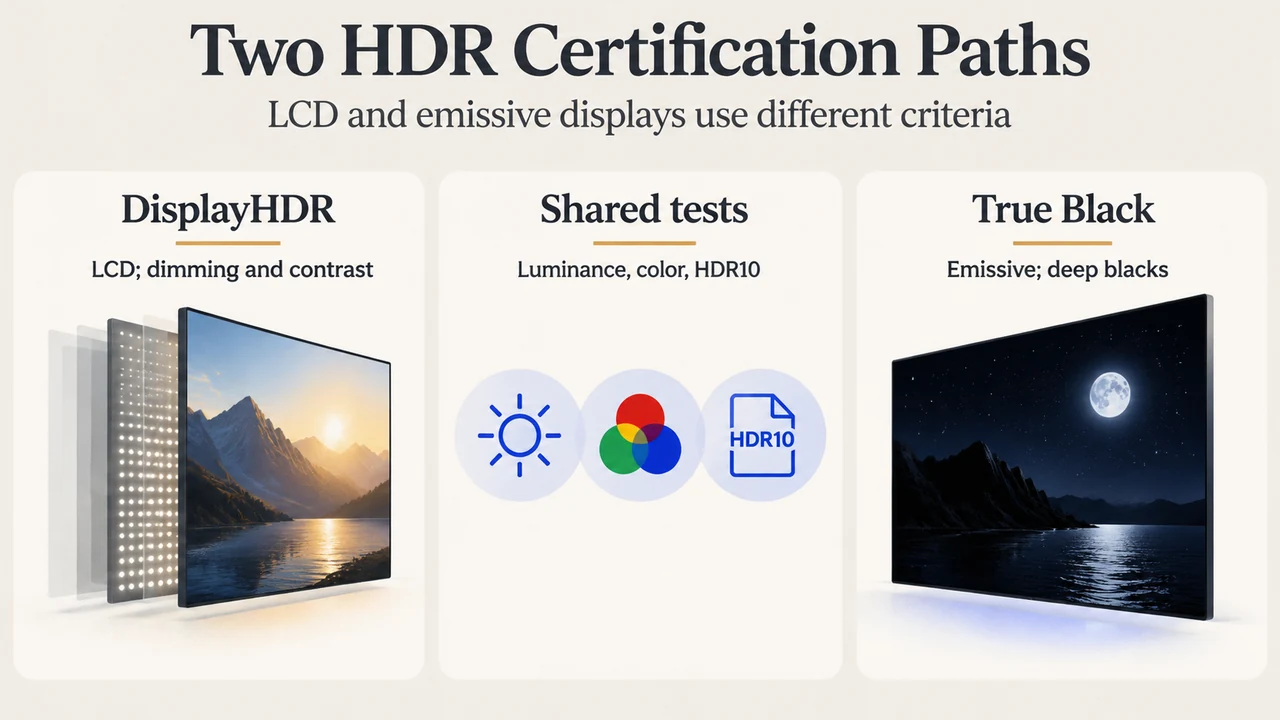
VESA defines separate certification standards based on underlying display technology:
- DisplayHDR: Geared toward liquid crystal displays (LCDs). Under CTS 1.2, achieving higher contrast ratios on an LCD requires modulating backlight brightness through active dimming—specifically 1D local dimming (or better) for DisplayHDR 500 and 600, and 2D local dimming (or better) for DisplayHDR 1000 and 1400.
- DisplayHDR True Black: Optimized for emissive display technologies, including organic light emitting diodes (OLED) and future microLED displays, where individual pixels emit light.
VESA CTS 1.2 Specification Comparison
Both DisplayHDR and DisplayHDR True Black standards require support for the industry-standard HDR10 format, a 10-bit video signal per channel, a minimum driver-IC bit depth of 8-bit plus 2-bit dithering (8b+2), and a minimum 8-bit digital-to-analog conversion. The two tracks specify distinct thresholds across core test metrics:
| Specification Metric | DisplayHDR (LCD) | DisplayHDR True Black (Emissive / OLED) |
|---|---|---|
| Target Technology | Liquid Crystal Displays (LCDs) | Emissive displays (OLED, microLED) |
| Defined Tiers | 400, 500, 600, 1000, 1400 | 400, 500, 600, 1000, 1400 |
| 8% Center Patch Peak Luminance | 400 to 1400 cd/m² (matches tier rating) | 400 to 1400 cd/m² (matches tier rating) |
| Full-Screen Flash Test Minimum Luminance | 400, 500, 600, 1000, 1400 cd/m² | 250, 300, 350, 500, 700 cd/m² |
| Full-Screen Long-Duration Test Minimum Luminance | 320, 320, 350, 600, 900 cd/m² | 250, 300, 350, 500, 700 cd/m² |
| Maximum Black Level (Dual Corner Box Center) | 0.4 cd/m² (tier 400) down to 0.02 cd/m² (tier 1400) | 0.0005 cd/m² across all tiers (400 through 1400) |
| Full Luminance Checkerboard Max Black Level | N/A | 0.0005 cd/m² |
| Static Contrast Ratio Requirement | 1,300:1 (tier 400), 7,000:1 (500), 8,000:1 (600), 30,000:1 (1000), 50,000:1 (1400) | N/A (governed by 0.0005 cd/m² black level) |
| Rise-Time Specification (Max Frames to Max Luminance) | 8 frames | 2 frames |
| Backlight Control Accuracy (8-bit) | Required across all tiers | N/A |
| DCI-P3 CIE (D65) Color Gamut Coverage | 90% (tier 400), 95% (tiers 500 through 1400) | 95% across all tiers |
| Average ΔITP Color Error (96 Color Patches) | 8 (tiers 400–600), 6 (tiers 1000–1400) | 8 (tiers 400–600), 6 (tiers 1000–1400) |
Testing Protocols and Criteria Under CTS 1.2
VESA CTS 1.2 defines specific test conditions to verify compliance across both standards:
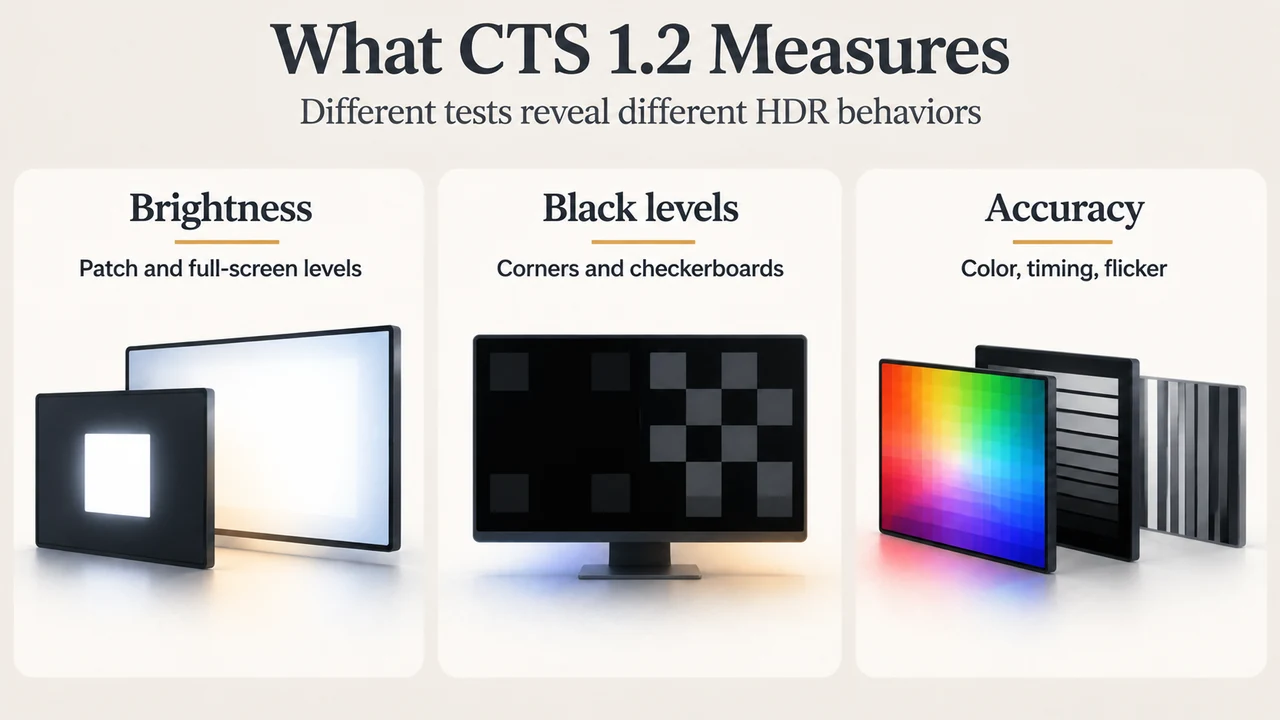
- Peak White and Full-Screen Luminance: Measured with an 8% screen center patch surrounded by a 2% Average Picture Level (APL) background. CTS 1.2 tests full-screen luminance through both a brief flash test (representing brief events like explosions) and a sustained long-duration test. Emissive True Black tiers allow lower full-screen thresholds (250 to 700 cd/m²) compared to LCD tiers (up to 1400 cd/m² flash and 900 cd/m² long-duration).
- Black Level and Active Dimming: Black levels are tested using a Dual Corner Box pattern with maximum white displayed simultaneously in two corners. True Black tiers mandate a maximum black level of 0.0005 cd/m² for the center patch and during a full-luminance checkerboard test. LCD tiers evaluate active dimming ratios using 5 cd/m² and 50 cd/m² checkerboards to assess backlight reduction.
- Rise Time: Measures how rapidly a display transitions from black to maximum luminance. The maximum permissible transition time is 2 frames for True Black emissive displays and 8 frames for DisplayHDR LCDs.
- Subtitle Flicker: Verifies that local dimming modulation (combining backlight power and LCD transparency control) keeps stable scene elements within a 10% to 13% luminance difference when an element abruptly changes luminance.
- Color and Contrast Metrics: Color accuracy is evaluated using 96 X-Rite ColorChecker SV patches tested across three luminance points (50 cd/m², 100 cd/m², and 50% of the tier level). Static contrast ratios measure black and white points on a single test image to evaluate on-scene contrast.
Verifying Certified Products
VESA notes that displays referring to uncertified terms like “HDR-400” or “HDR-1000” rather than official designations like “DisplayHDR 400” or “DisplayHDR 1000” may not meet certification standards. Consumers can verify certified models directly through the registry at displayhdr.org.
Research Methodology and Limitations
This document was prepared exclusively from public technical criteria and excerpts published by VESA on displayhdr.org and displayhdr.org/performance-criteria/ for Compliance Test Specification (CTS 1.2). It does not evaluate physical laptop implementations, chassis thermals, battery consumption, panel manufacturing layers, or comparative consumer hardware reviews. Competing third-party editorial coverage was not available in the provided evidence.
Text version of the diagrams
- Two HDR Certification Paths: DisplayHDR — LCD; dimming and contrast; Shared tests — Luminance, color, HDR10; True Black — Emissive; deep blacks
- What CTS 1.2 Measures: Brightness — Patch and full-screen levels; Black levels — Corners and checkerboards; Accuracy — Color, timing, flicker