USB Power Delivery (USB PD) Revision 3.1 enables delivering up to 240W of power over full-featured USB Type-C cables and connectors. Prior to this update, USB PD was limited to 100W using a solution based on 20V with USB Type-C cables rated at 5A. According to technical documentation from the USB Implementers Forum (USB-IF), the USB Type-C specification was updated to Release 2.1 to define 240W cable requirements, which combines with an updated protocol and power supply definition to expand power delivery to applications where 100W was not adequate.
Supported Voltage Levels and Adjustable Supply Mode
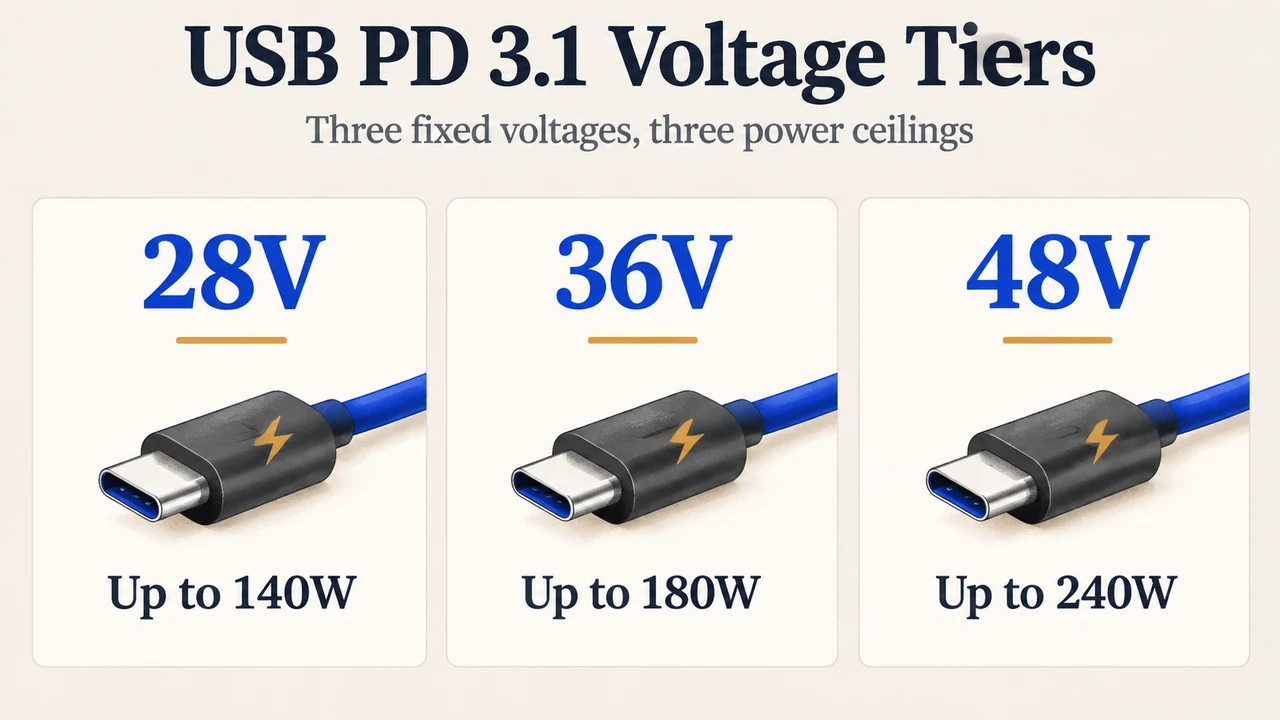
The USB PD Revision 3.1 specification adds three fixed voltage levels:
- 28V: Enables up to 140W.
- 36V: Enables up to 180W.
- 48V: Enables up to 240W.
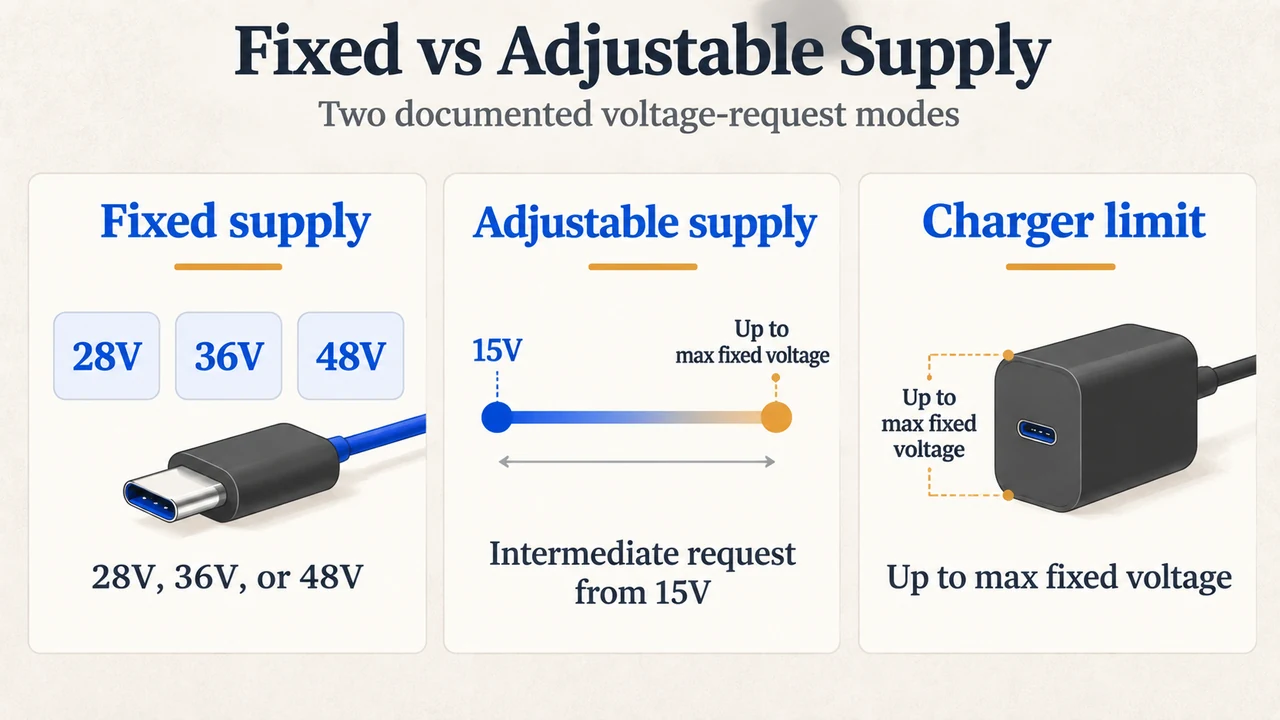
In addition to fixed voltage levels, the standard provides an adjustable voltage supply mode. This mode allows the powered device to request intermediate voltages between 15V and up to the maximum available fixed voltage of the charger.
Flexible Power Flow and Peripheral Management
Under USB Power Delivery, power direction is no longer fixed, enabling the product with power (whether host or peripheral) to supply it. The standard also provides system-level power management features:
- Allows each device to take only the power it requires, and request more power when an application demands it.
- Supports low-power use cases, such as headsets, to negotiate only the power they require.
- Enables optional hub communication with a PC for intelligent and flexible system-level power management.
- Allows battery-powered devices to receive increased charging current from a hub and return it temporarily when another device (such as an HDD) requires spin-up power.
Documented Application Examples
USB-IF documentation highlights several concrete configurations enabled by USB Power Delivery:
- Supplying higher power up to 240W to devices such as USB bus-powered hard disk drives (HDDs) and printers over a single full-featured USB Type-C cable and connector, eliminating separate power bricks.
- A wall-powered monitor providing power or charging to a laptop while continuing to display video.
- USB power bricks or chargers passing power through a laptop’s USB ports.
Text version of the diagrams
- USB PD 3.1 Voltage Tiers: 28V — Up to 140W; 36V — Up to 180W; 48V — Up to 240W
- Fixed vs Adjustable Supply: Fixed supply — 28V, 36V, or 48V; Adjustable supply — Intermediate request from 15V; Charger limit — Up to max fixed voltage
Research Method and Limitations
This answer was prepared directly from the supplied public technical excerpt from the USB Implementers Forum (USB-IF) regarding USB Power Delivery specifications. No hands-on testing, hardware teardowns, or benchmark measurements were performed. In addition, no accessible competing coverage was supplied, so comparative market analysis and differences among third-party commercial implementations cannot be evaluated from the evidence.