The Nikon Z50II is a DX-format (APS-C) mirrorless camera equipped with a 20.9-megapixel sensor and Nikon’s EXPEED 7 processing engine. Designed for photography and video capture, it incorporates high-speed multi-subject autofocus detection, dedicated on-body Picture Control styling, and versatile video recording options. This guide outlines the camera’s verified technical specifications, functional modes, and documented operating boundaries based on official manufacturer disclosures.
Sensor, Processing Engine, and Burst Capture
At the core of the Nikon Z50II is a 20.9-megapixel DX-format (APS-C) sensor paired with the EXPEED 7 image processing engine. The sensor is several times larger than typical smartphone image sensors. The camera offers a maximum standard sensitivity of ISO 51,200 supported by integrated noise reduction algorithms.
Driven by the EXPEED 7 engine, the camera supports high-speed burst shooting and Pre-Release Capture. Photographers should note the documented operational parameters for high-speed continuous modes:
- The camera can capture bursts as fast as 30 photos per second.
- High-speed continuous shooting modes C15 and C30 operate exclusively as JPEG-only electronic shutter modes.
- Because C15 and C30 utilize an electronic shutter, rolling shutter distortion may occur depending on subject movement and shooting conditions.
- Pre-Release Capture is supported to help record moments leading up to a shutter press.
Dedicated Picture Control Button and Nikon Imaging Cloud
The Nikon Z50II features a dedicated hardware Picture Control button on the camera body, allowing creators to select and adjust creative looks directly during shooting:
- 31 Built-in Presets: Pressing the Picture Control button provides immediate access to 31 built-in color presets designed for photos and videos.
- Custom Profiles: Users can create and save their own custom Picture Control presets in-camera.
- Cloud Picture Controls: Photographers can download bespoke Cloud Picture Control presets (Imaging Recipes) directly to the Z50II via Nikon Imaging Cloud.
- Cloud Photo Transfer: When connected over Wi-Fi, the complimentary Nikon Imaging Cloud service enables automatic upload of full-resolution image files directly to preferred cloud storage destinations, with unlimited storage available free of charge for up to 30 days.
Autofocus System and 9-Subject Detection
The Nikon Z50II utilizes a hybrid phase-detection and contrast autofocus system equipped with AF assist. The system provides 209 selectable focus points in single-point AF and 231 focus points in auto-area AF (available in photo mode with DX selected for image area). The autofocus detection range spans from −9 to +19 EV (measured in photo mode at ISO 100 and a temperature of 20 °C / 68 °F using single-servo AF-S and an f/1.2 lens).
Subject detection powered by EXPEED 7 automatically identifies and tracks nine distinct subject categories:
- People (including face and eye-detection autofocus)
- Animals (specifically dogs and cats, including face and eye-detection)
- Birds (supported by a dedicated [bird] AF mode)
- Vehicles (cars, motorbikes, bicycles, trains, plus a dedicated [airplane] AF mode)
Available AF-area modes in photo mode include Pinpoint AF, Single-point AF, Dynamic-area AF (S, M, and L), Wide-area AF (S, L, C1, and C2), Auto-area AF, and 3D-tracking. Video shooting supports Single-point, Wide-area (S, L, C1, C2), Auto-area, and Subject-tracking AF, alongside Full-time AF (AF-F) lens servo operation.
Video Capabilities and Creator Tools
The Nikon Z50II provides video features designed for content creation, recording, and live streaming:
- Resolutions and Frame Rates: The camera records 4K UHD at 60p, 4K UHD at 30p, and slow-motion video in Full HD at up to 120p.
- 10-Bit N-Log: Color grading flexibility is supported via N-Log recording, available when shooting in H.265 10-bit (MOV) format. Free professional 3D LUTs developed in partnership with RED are available for N-Log post-production.
- Product Review Mode: During filming, holding a product up to the camera prompts the Z50II to automatically adjust focus to keep the item sharp.
- UVC/UAC Streaming: Connecting the Z50II to a computer or compatible smartphone via its UVC/UAC-compliant USB port allows it to be used as a webcam for live streaming or video calls (additional software and drivers may be required).
- Video Self-Timer: The video record button can be programmed with a 2-second or 10-second countdown before recording initiates.
Image Stabilization and Field-of-View Boundaries
The camera’s stabilization behavior depends on lens selection and electronic settings:
- Optical Vibration Reduction: Lens-shift Vibration Reduction (VR) is available when using select DX-format and FX-format Nikkor lenses equipped with VR.
- Electronic Vibration Reduction: The camera features built-in electronic stabilization to reduce shake during handheld shooting. When electronic vibration reduction is activated, the angle of view becomes equivalent to approximately 1.25× the focal length of the mounted lens.
Hardware Architecture, Viewfinder, and Storage
The camera body integrates standard Nikon Z system components and physical controls:
- Lens Compatibility: Features the native Nikon Z mount, supporting more than 40 Nikkor Z lenses. F-mount Nikkor lenses can be used with a compatible mount adapter (restrictions may apply).
- Electronic Viewfinder: A 1.0-cm (0.39-inch), approximately 2,360,000-dot (XGA) OLED electronic viewfinder offering approximately 100% horizontal and vertical frame coverage, approximately 1.02× magnification (with a 50mm lens at infinity, −1.0 m−1), and 13-level manual brightness adjustment.
- Shutter & Flash: Features an electronically-controlled vertical-travel focal-plane mechanical shutter, electronic front-curtain shutter, and electronic shutter. Shutter speeds range from 1/4000 s to 30 s (extendable to 900 s in Manual mode). A built-in pop-up flash is included, synchronizing at shutter speeds up to 1/200 s or 1/250 s (auto FP high-speed sync supports speeds up to 1/4000 s).
- Storage Slot: Equipped with one memory card slot compatible with SD, SDHC, and SDXC media supporting the UHS-II bus interface.
Documented Operational Trade-offs
Based on official product specifications, photographers should consider these operational boundaries:
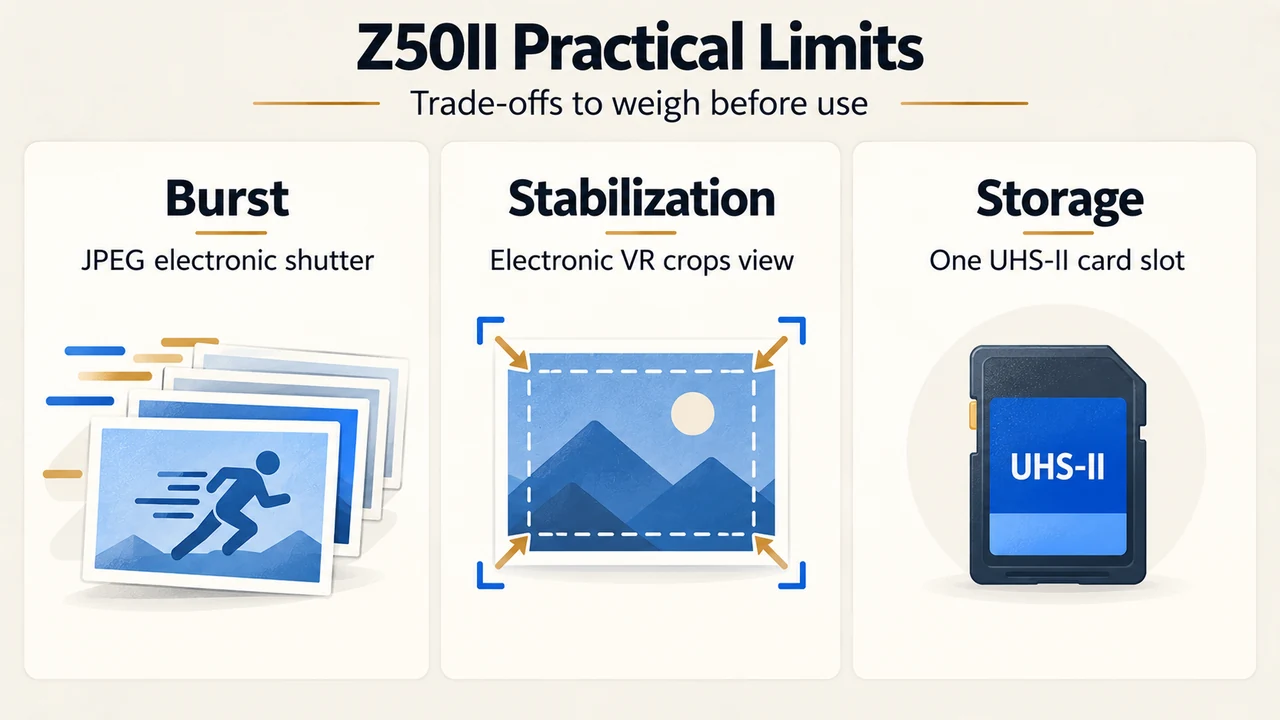
- Single Card Slot: With one UHS-II SD card slot, the camera cannot write simultaneous in-camera backups to a secondary card.
- Stabilization Crop: Enabling Electronic Vibration Reduction reduces the effective field of view to 1.25× the mounted lens focal length. Optical stabilization requires a lens equipped with Vibration Reduction.
- Electronic Shutter Constraints: Maximum 30 fps burst capture (C15/C30 modes) records strictly in JPEG format using the electronic shutter, which may exhibit rolling shutter distortion under certain conditions.
Text version of the diagrams
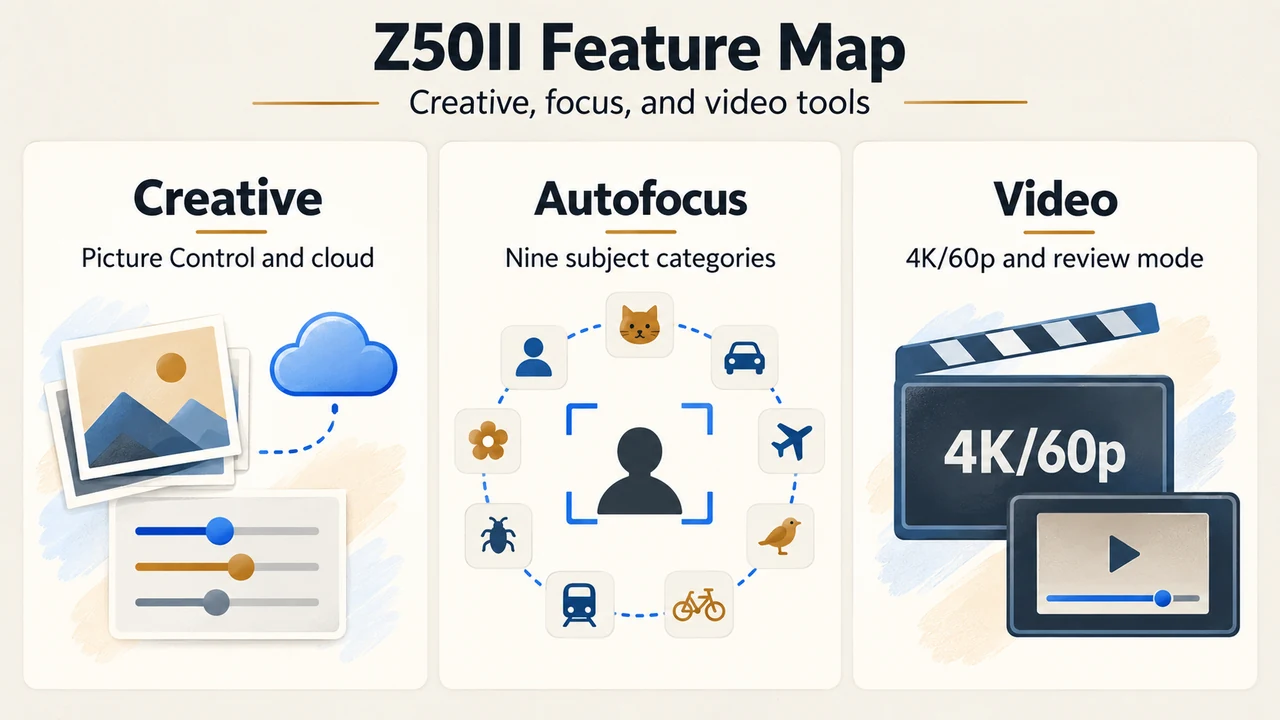
- Z50II Feature Map: Creative — Picture Control and cloud; Autofocus — Nine subject categories; Video — 4K/60p and review mode
- Z50II Practical Limits: Burst — JPEG electronic shutter; Stabilization — Electronic VR crops view; Storage — One UHS-II card slot
Research Methodology and Limitations
This technical explainer was prepared strictly from official public technical documentation and specifications published by Nikon USA for the Nikon Z50II. No hands-on testing, laboratory measurements, or third-party benchmark claims were conducted. This analysis is limited to the supplied primary documentation; competing camera coverage, retail pricing, and regional package availability were absent from the visible source excerpts and are excluded.