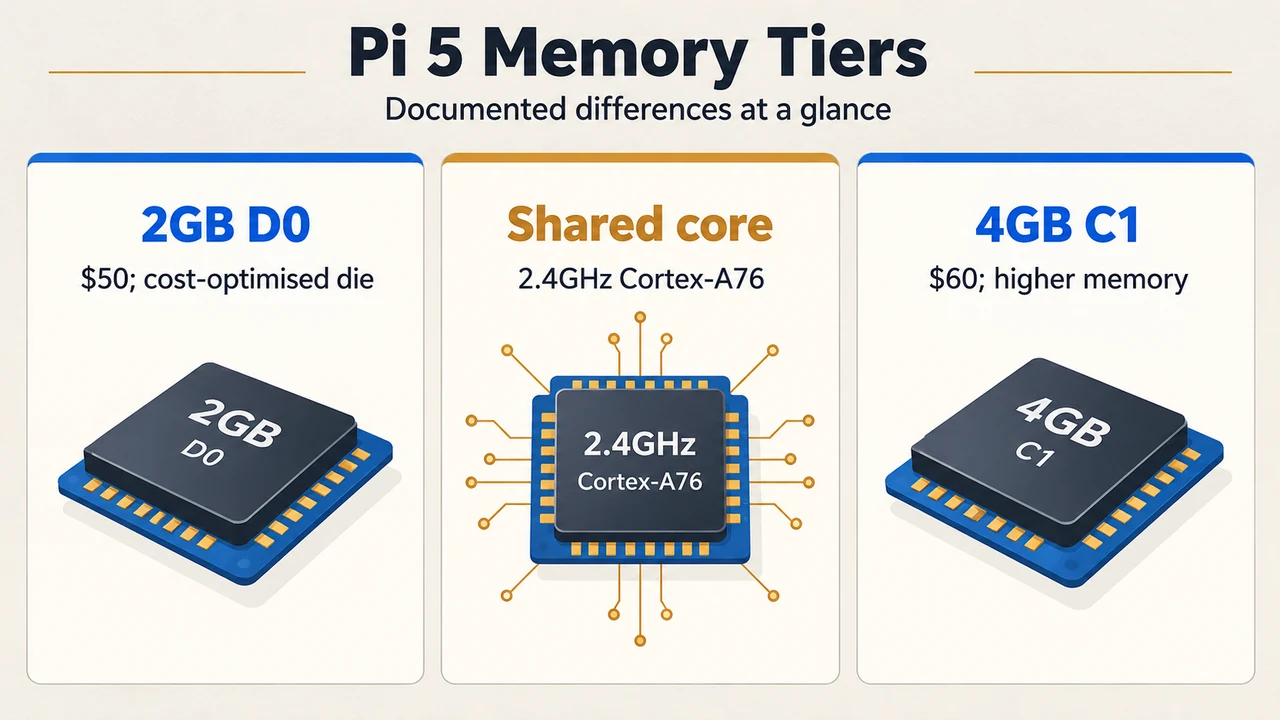
The Raspberry Pi 5 2GB adds an entry-level tier to the flagship Raspberry Pi 5 family at an official launch price of $50. Raspberry Pi introduced this board to lower the entry cost below the earlier 4GB base model, which launched at $60. Achieving this $10 reduction involved two specific design changes: halving the memory capacity to 2GB and introducing the D0 stepping of Broadcom’s BCM2712 application processor.
BCM2712 Stepping Differences and Dark Silicon Removal
The 4GB and 8GB models of Raspberry Pi 5 rely on the BCM2712C1, a 16nm application processor manufactured by Broadcom. That silicon contains extra circuitry intended for other markets that Raspberry Pi does not need. On the C1 stepping, this unneeded circuitry—termed “dark silicon”—is permanently disabled in hardware, but it still occupies physical die area and increases manufacturing costs per wafer.
According to Raspberry Pi’s launch announcement, the D0 stepping strips out this unneeded functionality, leaving only the components required by the Raspberry Pi platform. This die optimization lowers manufacturing costs for the processor. From the user’s perspective, Raspberry Pi states that the D0 stepping maintains functional parity with the earlier processor:
- CPU: The same quad-core Arm Cortex-A76 processor running at 2.4GHz.
- Multimedia: The same VideoCore multimedia capabilities.
- I/O Controller: Interfacing provided by the companion RP1 I/O controller developed by Raspberry Pi.
- Expansion Bus: The same PCI Express bus present on the Raspberry Pi 5 platform.
Documented Workload Boundaries
Because the D0 stepping provides functional parity with earlier revisions, the compute core retains its 2.4GHz quad-core performance. However, memory capacity differs between tiers, which defines the supported workload boundaries:
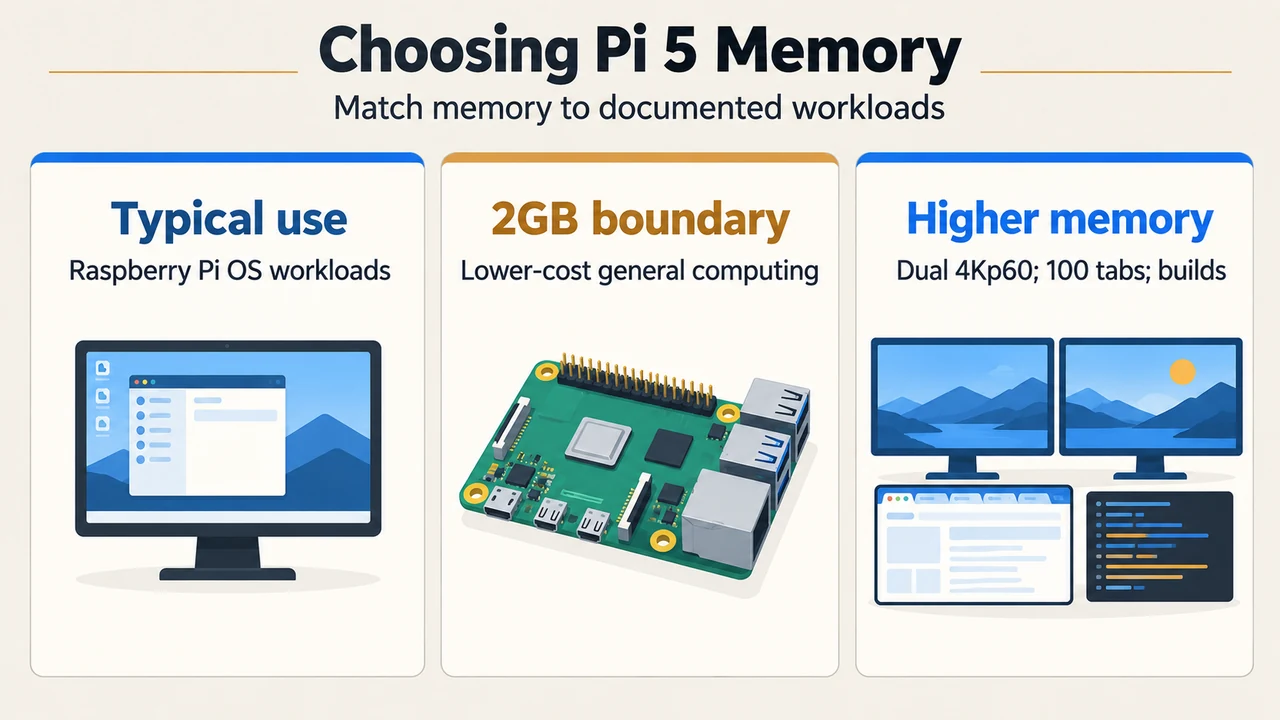
- Target Audience for 2GB: Raspberry Pi notes that their software optimizations keep the resource footprint of Raspberry Pi OS lighter than most general-purpose Linux distributions, stating that the $50 2GB model works well for many users and standard computing use cases.
- Higher-Memory Boundaries: Raspberry Pi states that the most demanding users will likely prefer higher-memory variants (such as the 4GB or 8GB models) for workloads like driving dual 4Kp60 displays, running a hundred browser tabs, or compiling complex software from source.
Comparison: Raspberry Pi 5 2GB vs. Raspberry Pi 5 4GB
The documented differences between the 2GB and 4GB models reflect pricing, memory capacity, and processor stepping:
| Feature / Attribute | Raspberry Pi 5 2GB | Raspberry Pi 5 4GB |
|---|---|---|
| Base Launch Price | $50 | $60 |
| Application Processor | Broadcom BCM2712 (D0 Stepping) | Broadcom BCM2712 (C1 Stepping) |
| Die Implementation | Cost-optimised die with unneeded functionality stripped away | Die contains permanently disabled dark silicon |
| System Memory | 2GB | 4GB |
| Processor Specs | Quad-core Arm Cortex-A76 at 2.4GHz | Quad-core Arm Cortex-A76 at 2.4GHz |
| I/O Controller | Raspberry Pi RP1 | Raspberry Pi RP1 |
| Expansion Bus | PCI Express bus | PCI Express bus |
| Stated Workload Focus | Standard computing workloads on Raspberry Pi OS | Demanding workloads (e.g. compiling from source, 100 tabs, dual 4Kp60 displays) |
Research Method and Limitations
This overview was prepared strictly from the supplied public source excerpts regarding the Raspberry Pi 5 2GB release. Material limits include truncated source text and the absence of accessible competing coverage. Unverified technical specifications not stated in the primary text (such as specific RAM standards, PCIe generation versions, or unmeasured thermal and swapping behavior) have been excluded, and claims are limited to documented architecture, pricing, and officially stated workload boundaries.
Text version of the diagrams
- Pi 5 Memory Tiers: 2GB D0 — $50; cost-optimised die; Shared core — 2.4GHz Cortex-A76; 4GB C1 — $60; higher memory
- Choosing Pi 5 Memory: Typical use — Raspberry Pi OS workloads; 2GB boundary — Lower-cost general computing; Higher memory — Dual 4Kp60; 100 tabs; builds