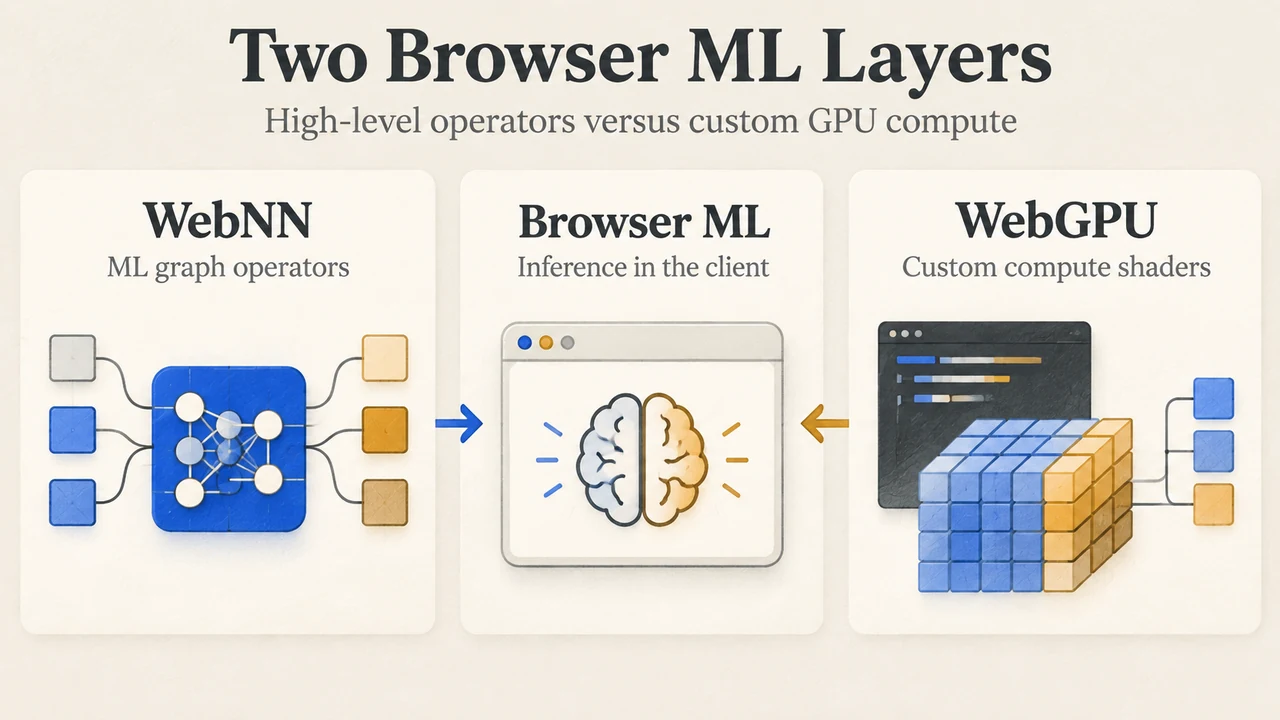
In-browser machine learning inference allows web applications to execute neural network workloads directly on client devices. According to documentation from the W3C Web Neural Network API Working Draft and the ONNX Runtime Web Documentation, client-side inference provides faster execution for models optimized for local hardware, offline execution, and reduced cloud serving costs.
For privacy, running inference in the browser keeps input data such as images, audio, and video streams within the browser sandbox rather than transmitting it to remote servers. However, this is an inference-path property rather than a whole-application privacy guarantee, as web applications still govern broader network and data handling policies outside the inference step.
Architectural Differences: High-Level Abstraction vs. Custom Shaders
The core distinction between WebNN and WebGPU centers on their architectural abstraction and how operations are constructed:
- WebNN (W3C Working Draft): WebNN defines a hardware-agnostic abstraction layer designed specifically for machine learning. Instead of requiring developers to write custom shader code, WebNN builds upon pre-existing shaders and lower-level primitives provided by the browser or the underlying operating system. Developers define computational workloads via high-level operators and tensor structures (such as layout-dependent operators like
conv2d()). Because it does not intrinsically support custom shader authoring, WebNN is not prone to timing attacks that rely on shader caches or persistent shader data. - WebGPU: WebGPU exposes low-level GPU compute and rendering capabilities. Developers using WebGPU write custom compute shaders, interact with
GPUDevice, manage GPU memory buffers, and account for WebGPU compilation cache considerations. WebGPU identifies machine-specific artifacts as a privacy consideration.
Hardware Targeting and Interoperability
The two APIs expose different mechanisms for accessing underlying client hardware:
- Accelerator Targeting in WebNN: In WebNN, developers communicate hardware preferences via
MLContextOptionsusingpowerPreference("default","high-performance", or"low-power") and the boolean flagaccelerated. Whenacceleratedis true (its default setting), the platform attempts to use available massively parallel accelerators, such as a GPU or NPU, conditioned by the power preference. When set to false, it indicates a preference for CPU inference. WebNN does not allow web developers to enumerate or select specific physical devices, avoiding added fingerprinting entropy. WebNN can also create anMLContextfrom a WebGPUGPUDevice. - WebGPU Execution: WebGPU targets the graphics processing unit via explicit pipelines and compute commands executed on the GPU.
- Direct Interoperability: WebNN can exchange data directly with WebGPU. An application can export an output tensor to a WebGPU buffer using
context.exportToGPU(outputTensor), execute WebGPU compute or rendering commands, destroy the buffer reference withgpuBuffer.destroy(), and read results back viacontext.readTensor(outputTensor).
Execution Providers and Operator Support in ONNX Runtime Web
In-browser frameworks like ONNX Runtime Web (onnxruntime-web) allow developers to configure runtime backends across these technologies:
- GPU Processing: Supported via
webgl,webgpu, orwebnn(withdeviceTypeconfigured togpu). - CPU Processing: Supported via WebAssembly (
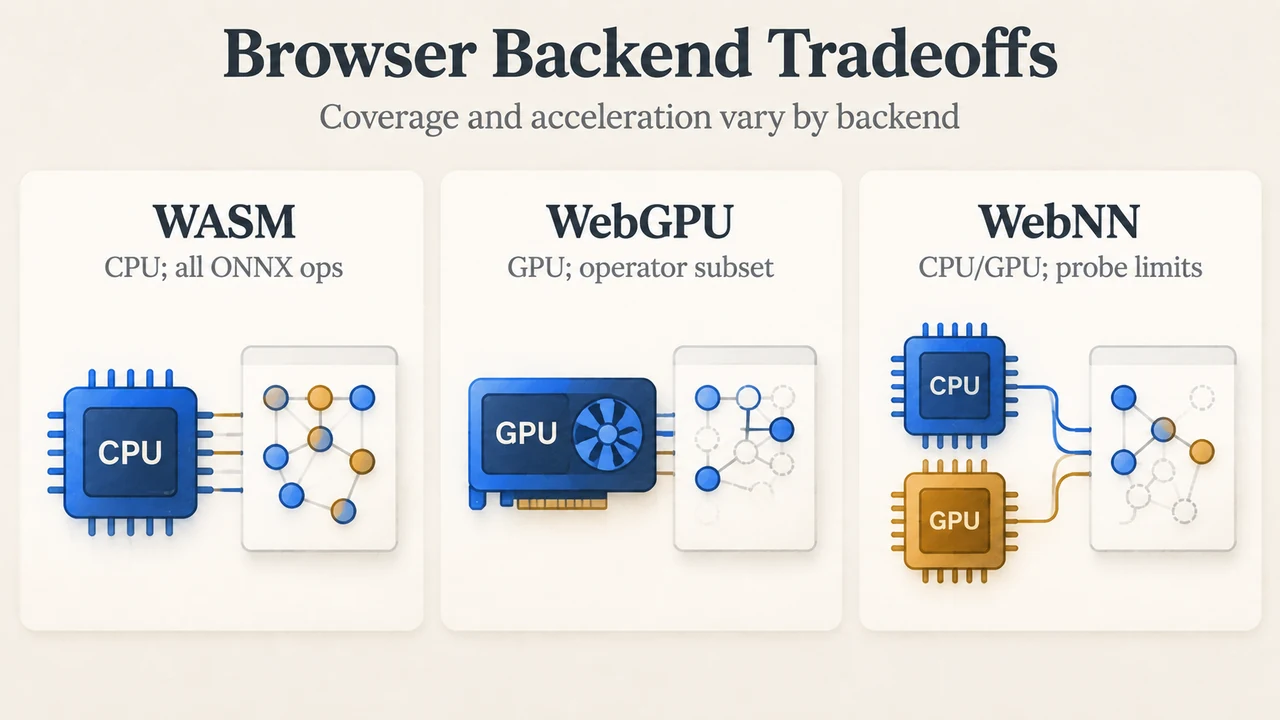
wasm, which serves as an alias to CPU) orwebnn(withdeviceTypeconfigured tocpu). - Operator Coverage Tradeoffs: All standard ONNX operators are supported when running on WebAssembly (CPU), whereas only a subset of ONNX operators are currently supported by WebGL, WebGPU, and WebNN backends.
- Probing Operator Limits in WebNN: WebNN provides the
opSupportLimits()method so applications can probe implementation-level variations before deployment. This inspects constraints such aspreferredInputLayoutandmaxTensorByteLength.
Text version of the diagrams
- Two Browser ML Layers: WebNN — ML graph operators; WebGPU — Custom compute shaders; Browser ML — Inference in the client
- Browser Backend Tradeoffs: WASM — CPU; all ONNX ops; WebGPU — GPU; operator subset; WebNN — CPU/GPU; probe limits
Research Method and Limitations
This answer was prepared strictly from the supplied public specification excerpts of the W3C Web Neural Network API Working Draft and the ONNX Runtime Web tutorial documentation retrieved on September 19, 2026. WebNN remains a W3C Working Draft, and documented API features in the specification do not establish universal browser implementation or universal hardware support across end-user devices. Furthermore, the W3C specification excerpt was truncated, and no competing coverage was available in the supplied evidence.