Transferring stored credentials across password managers has historically been an infrequent and largely manual process due to a lack of normative credential structures. To address this friction and reduce the risk of lost credentials during migrations, the FIDO Alliance developed the Credential Exchange Format (CXF) to establish standardized data structures for credential mobility.
What Is the FIDO Credential Exchange Format (CXF)?
The FIDO Credential Exchange Format (CXF), outlined in the FIDO CXF v1.0 Proposed Standard, defines normative data structures and formats for transferring credentials between credential providers. Historically, the lack of standardized structures created interoperability hurdles and data-loss risks. CXF addresses these challenges by specifying standardized data representations for accounts, entities, and credentials.
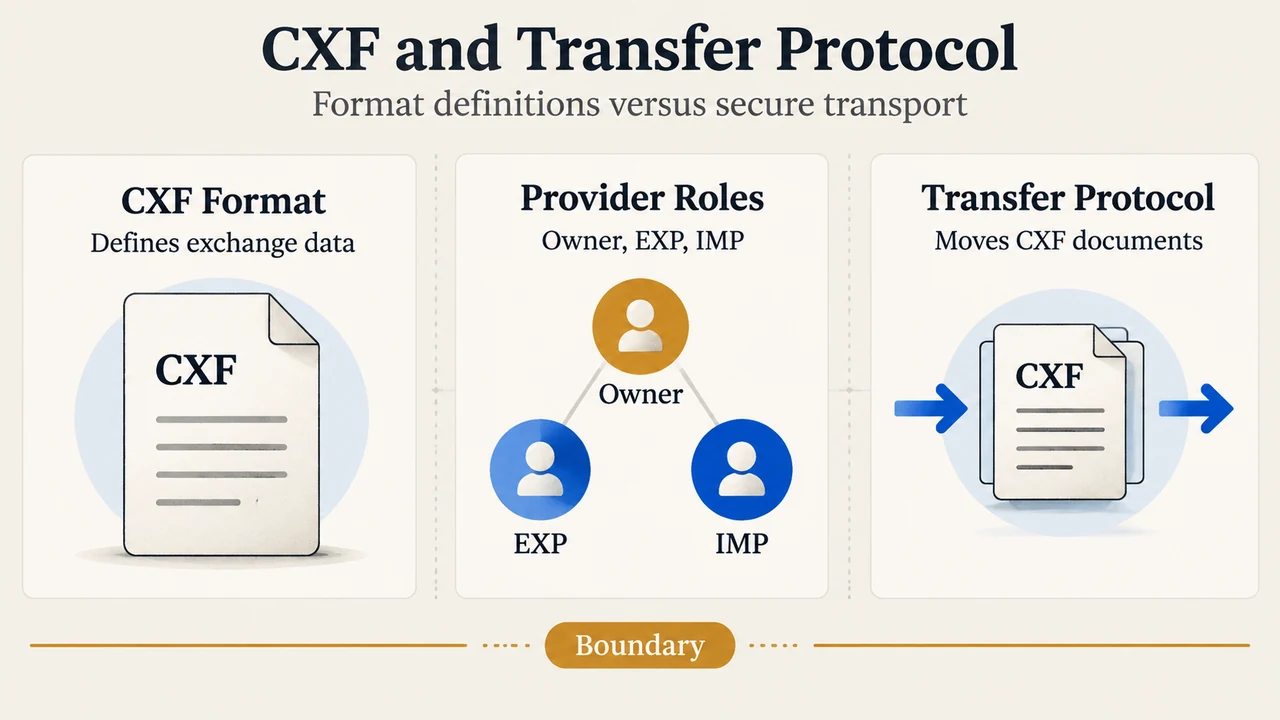
CXF intentionally separates data structures from the transmission mechanism. According to the specification’s scope, CXF defines the formats needed for credential exchange without making assumptions about the underlying transfer protocol used to transmit them.
Key Roles in Credential Migration
The CXF specification defines the primary roles participating in a credential exchange session:
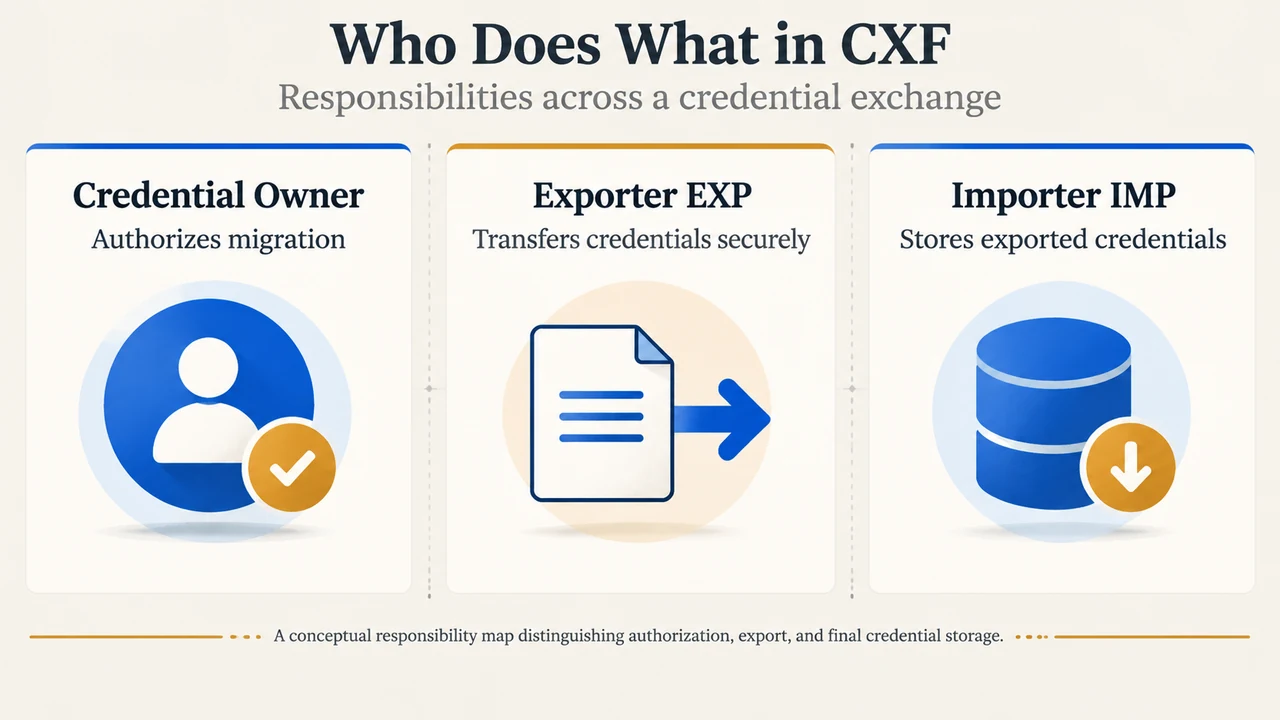
- Credential Owner: The entity (such as an individual end-user or someone authorized by an organization) capable of accessing and authenticating with stored credentials. The owner authorizes or delegates authorization of the migration between providers.
- Exporting Provider (EXP): The originating credential manager that transfers credential data to the destination. The exporter must ensure data is transferred securely either by encrypting it directly or by relying on orchestrator security guarantees.
- Importing Provider (IMP): The destination credential manager that serves as the final storage destination for exported credentials. A single provider may operate as both the exporter and importer during an exchange.
- Orchestrating Party: Software, such as an operating system or higher-level host platform, that coordinates the exchange between the exporting and importing providers.
Structure and Supported Credential Types
Entities within CXF are identified by probabilistically unique byte strings up to 64 bytes in length, which should not contain personally identifying information because they are shared in clear text during Credential Exchange Protocol (CXP) exchange sessions. The specification registers standardized structures across diverse credential models, including:
- SSH Keys: Represented under type
ssh-key, specifying public key algorithms (such asssh-rsa,ssh-ed25519, orecdsa-sha2-nistp256) and private keys formatted as PKCS#8 ASN.1 DER byte strings encoded in Base64url. - Time-Based One-Time Passwords (TOTP): Structured data aligned with historical authenticator key URI practices.
- Passkeys: Structures including private keys formatted as PKCS#8 ASN.1 DER Base64url-encoded byte strings, user entity identifiers, and optional FIDO2 extensions (such as PRF or HMAC-secret data). Signature counters with non-zero values are excluded from export, and importers must set them to zero.
- Personal Records: Structured formats for personal information, such as name entries (e.g.,
person-name).
Format Versus Protocol: CXF and CXP Boundaries
The FIDO CX specification directory tracks both CXF and the Credential Exchange Protocol (CXP). While CXF defines the normative data structures and formats for exchange documents, CXP is developed as the secure transfer protocol governing sessions and transmitting the CXF documents between importing and exporting providers.
Text version of the diagrams
- CXF and Transfer Protocol: CXF Format — Defines exchange data; Provider Roles — Owner, EXP, IMP; Transfer Protocol — Moves CXF documents
- Who Does What in CXF: Credential Owner — Authorizes migration; Exporter EXP — Transfers credentials securely; Importer IMP — Stores exported credentials
Research Method and Limitations
This technical summary was prepared exclusively from supplied public specification excerpts from the FIDO Alliance, specifically the FIDO CX Index and the CXF v1.0 Proposed Standard (August 14, 2025). Analysis is limited strictly to visible text; the specification index lists newer 2026 errata publications (such as cxf-v1.0-ps-errata-20260309.html) whose contents were not visible in the supplied excerpts. Additionally, certain credential definitions and CXP protocol details were truncated or omitted in the provided material, and no hands-on testing or competing coverage was available.