In high-refresh-rate displays and gaming sources, reaching uncompressed video modes beyond 4K at 60Hz depends on the physical signaling method and bandwidth supported by the HDMI port. While modern standards have evolved with the HDMI 2.2 specification introducing 96Gbps bandwidth and the Ultra96 HDMI Cable, products adhering to HDMI 2.1 specifications introduced Fixed Rate Link (FRL) technology up to 48Gbps to replace legacy Transition Minimised Differential Signalling (TMDS).
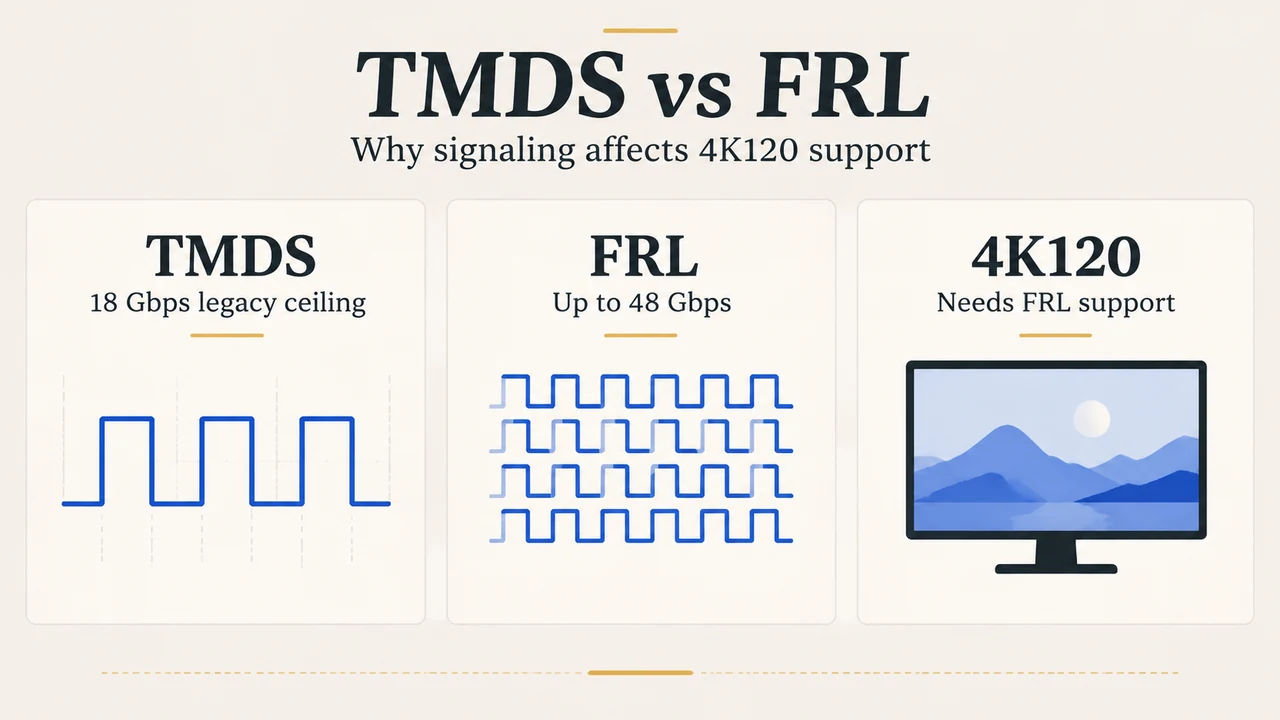
TMDS vs. Fixed Rate Link (FRL) Signaling
Legacy HDMI connections, including HDMI 2.0, rely on TMDS signaling. Under TMDS, the interface reaches a maximum transmission bandwidth of 18 Gbps. As documented in technical coverage citing HDMI Licensing Administrator, Inc. (HDMI.org), TMDS bandwidth supports 4K resolution at 60Hz with 8-bit color depth, but it cannot deliver uncompressed 4K at 120Hz with 10-bit color.
To support higher video bandwidths, HDMI 2.1 introduced FRL signaling technology. FRL is required to achieve uncompressed video formats above 4K at 60Hz and enables bandwidths up to 48 Gbps. It is also required for compressed video transport, allowing operation at lower data rates or ultra-high pixel rates. HDMI 2.1 retains mandatory TMDS support for backward compatibility with older devices, but achieving uncompressed 4K 120Hz requires a port that actively supports FRL.
Bandwidth Ceilings and Cable Requirements
The signaling architecture dictates the ceiling for transmission bandwidth and supported video formats without compression:
| Signaling Type | Maximum Bandwidth | Supported Uncompressed Formats | Required Cable Standard |
|---|---|---|---|
| Legacy TMDS (HDMI 2.0 era) | 18 Gbps | 4K at 60Hz (8-bit color) | Not specified in visible evidence |
| Fixed Rate Link (HDMI 2.1 era) | Up to 48 Gbps | 4K at 120Hz (10-bit uncompressed), 8K at 60Hz | Ultra High Speed HDMI Cable |
To support system configurations reaching up to 48 Gbps maximum bandwidth, the Ultra High Speed HDMI Cable was introduced in the HDMI 2.1 specification and entered the market in 2020. The newer HDMI 2.2 specification introduces an Ultra96 HDMI Cable supporting up to 96 Gbps, but HDMI 2.1 configurations running up to 48 Gbps require the Ultra High Speed HDMI Cable.
Display Compatibility and Verification for 4K 120Hz
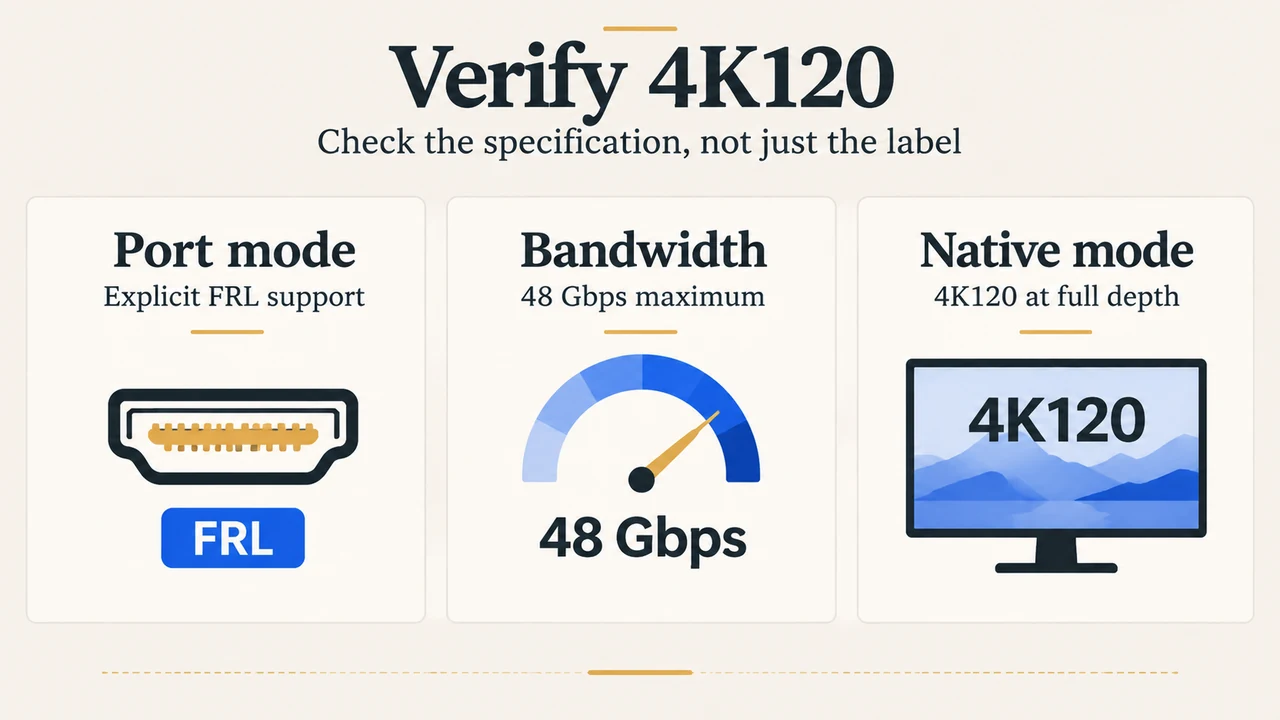
Because devices with HDMI ports may support different signaling ceilings, shoppers evaluating monitors for high-refresh gaming or professional editing must inspect documented specifications rather than relying on general version naming alone. A port operating strictly under legacy TMDS signaling remains restricted to 18 Gbps, making it incapable of delivering uncompressed 10-bit 4K at 120Hz. Verifying whether a display supports genuine FRL and 48 Gbps bandwidth requires checking the manufacturer’s technical specifications for explicit mention of FRL support, 48 Gbps throughput, and supported native refresh rates at full color depth.
Text version of the diagrams
- TMDS vs FRL: TMDS — 18 Gbps legacy ceiling; FRL — Up to 48 Gbps; 4K120 — Needs FRL support
- Verify 4K120: Port mode — Explicit FRL support; Bandwidth — 48 Gbps maximum; Native mode — 4K120 at full depth
Research Method and Limitations
This explainer was prepared strictly from public technical excerpts retrieved on September 18, 2026, comprising primary documentation from HDMI.org and editorial coverage from TFTCentral. The primary URL now hosts the HDMI 2.2 Specification Technology Overview; while it verifies HDMI 2.1 Ultra High Speed Cable parameters (up to 48 Gbps) and backward compatibility, detailed TMDS limits (18 Gbps, 4K60 8-bit) and HDMI 2.1 FRL requirements rely on quoted HDMI.org statements within the secondary TFTCentral article. Material limitations include truncation in the TFTCentral excerpt, an absence of physical-layer lane diagrams in the provided text, and unverified cable tier naming for legacy TMDS links. Claims are explicitly scoped to HDMI 2.1-era FRL products alongside recognition of the newer HDMI 2.2 standard.